
Dispatch can simply mean “dispatcher,” and a lot of owner operators don’t realize that this is what it is. A person who looks into load boards. Calls brokers. Handles paperwork.
That, however, is an understatement for what dispatch does in a healthy trucking business.
In practice, dispatch carries out the operational function that keeps vehicles on the streets, running smoothly and on a regular basis, with money flowing in every Monday and Thursday. It is not a matter of freight; it is a matter of coordinated freight, time, routes and broker connections, and set that out in a plan.
This is the reason why stressing out for each one’s load is not as essential as structured planning. We’ve discussed it in How Weekly Planning Beats’ Good Load’ Thinking Every Time, which describes in detail how the regular income of a trucker comes from discipline, not from taking random loads.
Dispatch is the program component that transitions trucking from reactive work to a work that is managed work.
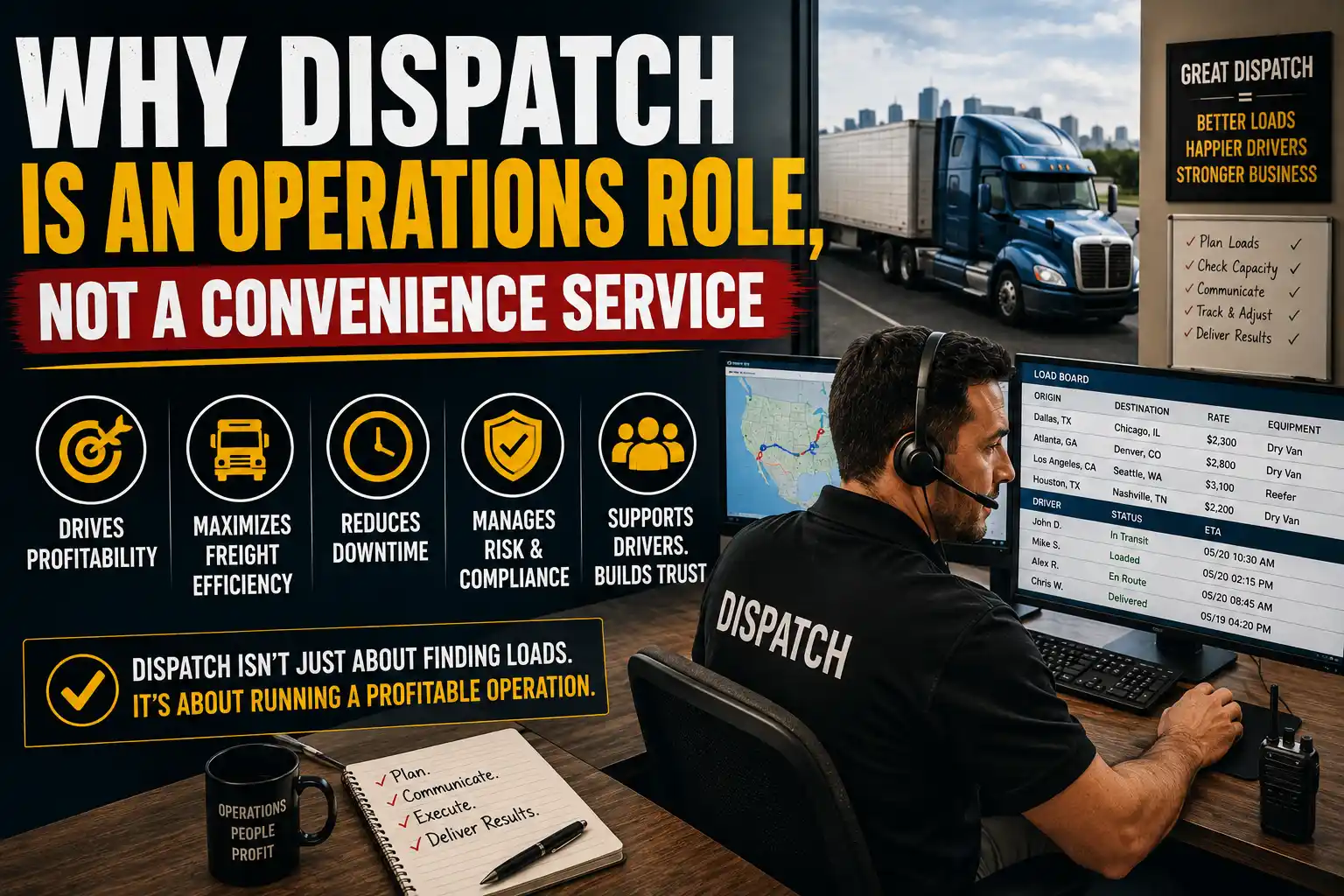
What Dispatch Actually Means in Trucking
In the trucking business, dispatch refers to the management and scheduling of freight transportation.
A professional dispatcher performs a lot more than searching for loads.
This job entails making the decisions that keep a truck productive all week long.
The typical duties of a dispatcher are:
- Attempts to strike deals with freight designers
- planning load sequences
- Making appointments for picking up and delivering people and goods
- Management of paperwork and compliance
- record the road freight market conditions.
- Interacting with brokers & shippers
- protecting reload opportunities
- For larger carriers, these roles typically would be allocated to entire operations departments.
Transportation coordinators and logistics coordinators are tasked with freight movement, arranging schedules, and making operations and logistics run smoothly throughout the supply chain, according to the U.S. Bureau of Labor Statistics.
But for independent owner-operators, the operational requirements are the same, without a ‘backbone’ of a large fleet to support them.
That’s where dispatch services come in.
The Operational Gap Facing Independent Owner-Operators
Sizable trucking companies do not usually fall short in the organization they have. This is using internal teams tasked with:
- dispatch coordination
- route planning
- broker relationships
- freight scheduling
These systems are in place to ensure trucks are operating 24/7 in an uninterrupted and predictable manner. But, for owner-operators, typically, they handle all aspects of their business on their own. That includes:
- driving
- negotiating loads
- communicating with brokers
- managing compliance paperwork
- maintaining equipment
- tracking finances
At this rate of workload, most drivers will start to drive rather reactively. They look for a new load after they have delivered the load. This can easily cause:
- empty miles
- inconsistent weekly revenue
- missed reload opportunities
- Sub-optimal location of freight markets
- Dispatch is really just about instilling order to this process.
Dispatch Is Not the Same as Finding Loads
A widely misunderstood aspect of dispatch is that it’s just a load finding service. But load boards already do just that. There are thousands of loads posted each day on websites like DAT and Truckstop.
But the true question on operations is not finding freight – it is determining which freight helps to keep the trucks productive tomorrow and the day after.
A high-paying load may sound great, for instance.
However, in the event that it drops off loads in a weak freight market, the driver might end up spending the following day looking for outbound loads.
A slightly lower paying load on a strong logistics corridor could result in more opportunities to reload and increased total weekly earnings. It’s about operational decisions, and that’s what dispatch does.
Doesn’t just consider how loads pay but how they connect.
Dispatch vs Freight Broker: Understanding the Difference
There is no denying that both dispatchers and freight brokers deal with freight, but in vastly different ways within the trucking industry.
Freight Brokers are the representatives of shippers. It is their duty to transport goods, load and unload, as well as locate carriers to transport them. Dispatchers represent carriers. Their job is to safeguard the truck’s productivity and earnings.
Due to this difference, dispatchers are focused on:
- Carlo Ancelotti and Didier Drogba find themselves doing some negotiating, but not on the part of the carrier.
- protecting reload opportunities
- Position of trucks in favour of the Freight markets.
We discuss this difference in depth in Difference Between Freight Brokers and Truck Dispatchers, parsing out the roles of each person and the legality behind it.
Once drivers realize this distinction, they realize that dispatch has done more than just matched the availability of freight—they work on the operations of the business.
Why Dispatch Exists in Every Large Trucking Company
Just about every successful transportation company has a dispatch department — whether it’s large or small.
These teams are in place because of the need for continual freight operations coordination.
When implementing dispatch planning, fleets can:
- coordinate multiple trucks
- manage freight lanes
- maintain broker relationships
- minimize empty miles
- Stabilize weekly revenue
American Transportation Research Institute (ATRI) studies indicate that one of the biggest cost factors for trucking companies is operational inefficiency, which includes empty miles.
Optimizing dispatch planning goes directly against these inefficiencies as it organizes and structures truck movements in freight markets.
If you do not have this layer of operation can be extremely difficult to overcome the scale of 1 truck.
In-House Dispatch vs Outsourced Dispatch
When trucking operations expand, often a decision is required on an operating choice. If you want dispatch in-house or to a professional dispatch provider? Depending on the size and nature of the operation, each model has the following strengths.
Many independent carriers often start with outsourced dispatch instead because they can get the operation know-how without hiring full-time staff members.
Larger fleets are likely to have their own dispatch staff when they start to expand vehicle volume.
In our article, In-House vs Outsourced Dispatch, we delve into the differences in cost, control, and flexibility. No matter what type of carrier models is selected, dispatch is still operations.
How Dispatch Improves Trucking Operations
When dispatch planning is structured correctly, it improves several core operational metrics.
Reduced Empty Miles
Strategic positioning helps trucks remain in freight-dense markets.
Faster Reload Cycles
Monitoring freight markets in advance allows dispatchers to secure loads before deliveries occur.
Stronger Broker Relationships
Consistent communication with brokers often improves reload access and scheduling flexibility.
Stable Weekly Revenue
Load sequencing creates predictable income rather than relying on occasional high-paying loads.
Studies of transportation logistics consistently show that coordinated load planning improves vehicle utilization and reduces operational inefficiencies across freight networks.
In other words, dispatch transforms trucking from a reactive activity into a structured business operation.
Why Some Drivers Initially Resist Dispatch
Initially, many of the owner operators would be reluctant to use dispatch services. This sometimes stems from the notion that independent drivers are better equipped to handle all aspects of their business.
Independence is one of the hallmark attributes of trucking; however, so is operating a profitable trucking operation.
Any time spent looking for loads, discussing rates and communicating with brokers is time that is not being used to increase revenue miles. Dispatch does not take the place of the driver – the business owner.
Rather, dispatch service is used to execute decisions necessary for the efficient running of a business.
Dispatch Is the Operating System of a Trucking Business
Essentially, dispatch is what operations management is for any type of business, including in the trucking sector. It status quo-ordinates resources, time and demand.
Even in the profitable industries, without operational coordination, it becomes chaotic. By it, enterprises turn out to be predictable and scalable.
The role of dispatching is found in most transportation service companies, ranging from small regional transportation companies right through to national companies. The only difference relates to who does the operational work.
Dispatch Turns Small Carriers Into Structured Operations
Independent owner operators tend to begin the adventure of owning their own business by doing everything by themselves.
As time goes on, the most effective operators learn that it’s the structure that counts more than single loads.
Dispatch provides the structure. It structures freight choices in a taciturn of reuse operational flow. It is a facilitator of loadings to freight markets. Keeping the reload timing and weekly utilization safe.
It is, and it’s how a trucking business can carry out with a ton of discipline to resemble much greater carriers.