

In the trucking industry, empty miles are of great significance for logistics companies and owner-operators. Empty trucks that are travelling without cargo add to serious costs, added amounts of fuel and carbon emissions.
Reducing empty miles by route planning, efficient logistics operations, and cooperating with freight dispatchers can help trucking businesses improve operational efficiency and generate more revenue. Whether dealing with the LTL shipments or returning, optimising delivery routes ensures that all trucks have a destination in mind so that the entire supply chain can benefit from it.
What is Empty Miles?
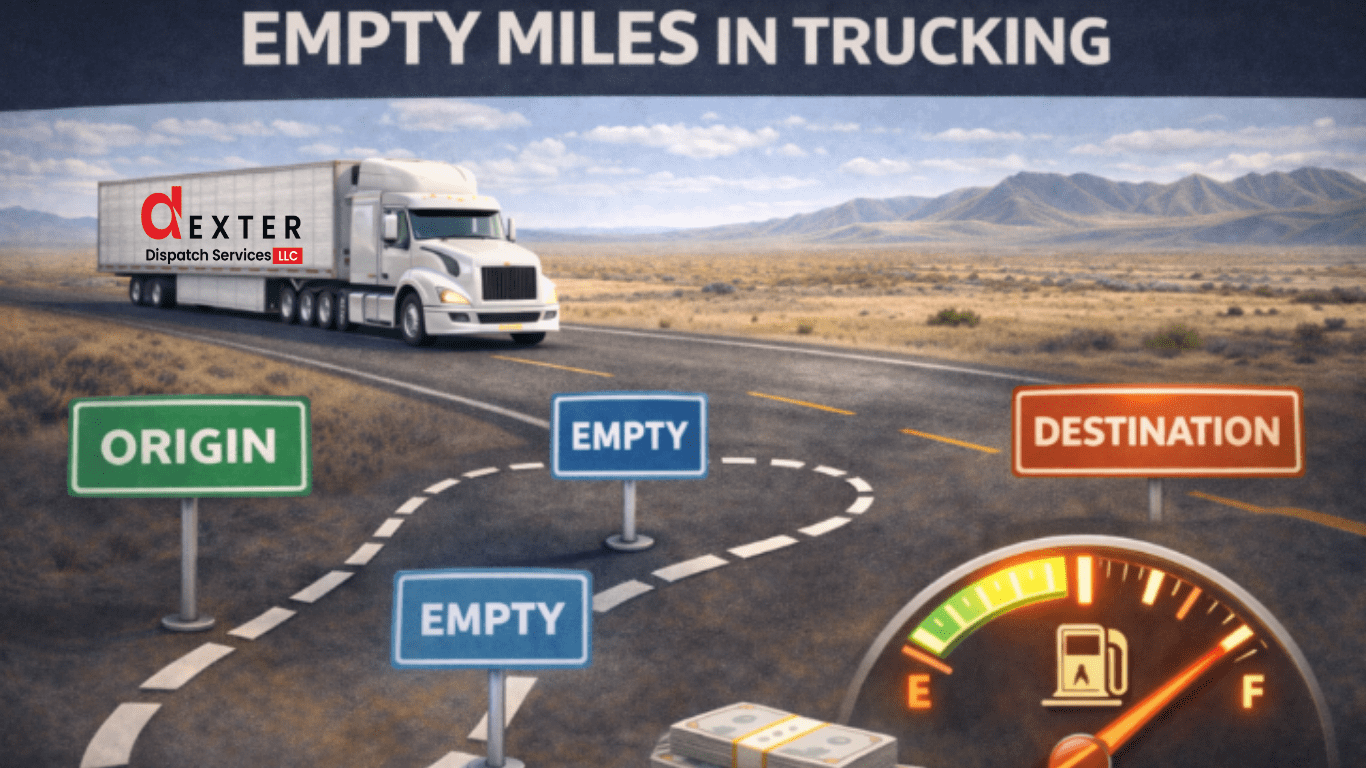
Empty miles concept can be described as the miles driven by trucks without any cargo. They are also referred to as deadhead miles or unloaded miles. In the freight transportation industry, many logistics companies and owner-operators are dealing with the problems of empty trucks on the road. Every single mile driven with no cargo is less money, which hurts the freight network.
The primary scenario in which the empty miles can occur is the return leg of a shipping process. After a delivery, trucks might go back to base or the next location with no load.
Fewer empty miles means that more trucks are roaming with cargoes. This helps increase operational efficiency and improve the sustainability of the environment. In addition, reduced empty miles result in less fuel consumption and, consequently, lower expenses.
Thus, empty miles indicate inefficient routing, which can be addressed by better planning and advanced algorithms.
Financial Impact of Empty Miles on Trucking Operations
Empty miles can be extremely costly to logistics operations. When trucks are operating without freight they are non-revenue miles that contribute to operational costs. This means that even though truck drivers are receiving money, the truck is not making money because it is not being used to transport cargo.
In addition to this, empty miles can lead to higher fuel intake and greater wear and tear to distributed goods vehicles. For companies that strive to minimize their carbon footprint, empty miles are another problem, since the more fuel is used, the more carbon is emitted.
Logistics companies and other businesses can apply advanced route optimization algorithms to find opportunities to cut down empty miles. This can lead to cost savings and better profitability.
Overall, reducing empty miles saves money and contributes to making the logistics industry more sustainable and efficient.
Strategies to Reduce Empty Miles in Trucking
Nowadays, every mile counts when it comes to the transportation industry. Thus, deadhead miles reduction is a top priority for most logistics corporations and independent truck drivers.
Reliable strategies of how to deal with empty miles can be useful to the supply chain and the US logistics industry as a whole. Four main strategies are route planning, the use of reverse logistics, the use of load boards and the implementation of multi-stop routing.
Route Optimization and Planning
The basis of reading empty miles is routing optimisation. With the help of advanced technologies and tools, trucking businesses can optimise their routes. This involves considering the weather conditions, traffic, and other factors. This process ensures that the delivery vehicles move along the best possible routes without taking inefficient routes that result in empty vehicles on the road.
Carefully planning routes for delivery can make these miles revenue-generating activities instead of just empty miles. In many cases, even the entire number of miles travelled by a truck can be planned in order to limit empty miles and cut down transportation costs.
With decreased fuel use and costs, there are savings for the companies which benefit the network of freight. This approach has proven its impact of making the entire system more efficient as a result.
Leveraging Backhaul and Reverse Logistics
Another strategy to fight empty miles is to make plans for the return trip by backhaul and reverse logistics. Instead of unloaded trucks driving back to the distribution centre or their base without any cargo, companies can find loads for the journey back on their trip. This means that the trucks are used for both out and back delivery of cargo.
By taking advantage of the reverse logistics, companies can load their vehicle with shipping from multiple customers. When a truck takes up a pickup on the way back, it turns unnecessary empty miles into revenue-raising tasks. This approach confronts running expenses connected with deadhead miles.
Businesses can use that using load boards to find a load for a reverse journey or consider cooperating with freight dispatchers to find a load. As a result, there are fewer trucks that travel with no load.
Using Freight Matching
Modern load boards and freight matching tools changed the way that logistics operations deal with trucking miles. These platforms match truckers with available cargo that matches their route and preferences. With an easy load search, drivers can easily find shipments that fit into their schedules.
When freight matching systems are in place, the mile is more likely to produce profit. This ensures that delivery vehicles are constantly loaded with cargo and are not doing empty miles. Whether you are part of a large logistics company or operating independently as a driver, these are some tools that help to optimise the shipping route such that miles are not wasted.
Implementing Multi-Stop Routing
Another effective method is multi-stop routing, which enables the delivery vehicle to make multiple stops on its journey. This helps to fill the truck and makes every mile more productive.
For example, a truck can start from a distribution centre and deliver to one customer and collect a load from another and then move to the next destination. This is particularly successful for less-than-truckload shipments, where cargoes from multiple customers are combined into one truck.
By planning stops on the way, logistics operations can plan shipping routes so that each leg of the trip is used in the plan to generate revenue.
With advanced tools and careful planning, apart from requiring fewer trucks, the same number of stops can be planned.
Because of its simplicity, this strategy is accessible for logistics companies of all sizes. The trucking industry has adopted it with the intention of making a big impact on cutting empty miles.
How Truck Dispatchers Can Help Reduce Empty Miles
Truck dispatchers can eliminate a great deal of empty miles. They help drivers to find loads and plan routes. With the right tools, truck dispatchers help to increase the overall efficiency of their operations and save the customers money.
At Dexter Dispatch Services, we provide dispatch services for truck drivers and fleets that are meant to help you to optimise shipping routes and avoid empty trips. With our assistance you will be spending more time moving cargo and less time driving empty vehicles.
Our service is made for drivers. Our expert dispatchers can match your truck and preference with loads. We don’t force dispatch; leave to choose the load you want, and you can manage your schedule yourself.
The fact is, however, we’ve always got your back. Whether you’re a company driver or an independent carrier, we help you find loads to match your route – helping you save on fuel costs and usage. It also contributes to making more money by converting non-revenue trips to revenue-generating activities.
When you don’t drive empty cargo, you are helping to improve delivery processes and make your business’s shipping process more efficient.
When cooperating with us, you can benefit from:
- Optimised routing. Our dispatchers are ready to help to find the most efficient route, taking into consideration several factors, such as weather conditions or traffic.
- Load matching. Get access to high-paying freight that matches your truck and route preferences and schedule to minimise empty miles and maximise earnings.
- No forced dispatching. We provide all the information about the load, but the last decision is after you.
- Increased earnings. Reduced deadhead miles and downtime can result in a more efficient run and possibly higher pay.
- Work-life balance. Efficient dispatch and scheduling can result in more predictable hours of work and less stress on the road.
- Constant support. Georg Klelaro Keep in touch with dispatchers and support teams via integrated mobile communications for rapid resolution of problems.
- Regulatory compliance/assistance. Automatically monitor and record your driving hours and routes and make it more convenient for compliance with industry regulations.
With passenger cars and buses, why drive empty when you can haul profit spread loads? Let Dexter Dispatch Services introduce you to freight to match your truck and haul time. Join us today!
Conclusion
Minimising empty trips is therefore key to improving the freight network and increasing cost savings and reducing carbon dioxide emissions. By implementing advanced computer algorithms for route planning and load-matching technology, corporations can see opportunities to fill up empty return trips.
By partnering with a professional dispatch service, logistics companies and independent contractors can help optimise routes, secure better loads and increase profitability.
At Dexter Dispatch Services, we work with trucking companies and owner-operators by helping them maximise their earnings by decreasing empty miles and boosting their overall efficiency. Our team of expert dispatchers helps assure load matching, route optimisation and regulatory compliance so as to ensure fewer vehicles on the road without cargo.
Take command of the number of trucking miles and empty miles your business runs today! Contact Dexter Dispatch Services and let us help you to make all trips profit-driven.
👉 Contact Dexter Dispatch Services at www.dexterdispatchservices.com or call us at [682-336-0385]