

Until reefer rates are factored into the cost of the temperature control they need, they appear like a premium. The premium is genuine. So is the cost of one self-inflicted (corked) load.
Generally, operators operating between a dry van and a refrigerator operate on the basis of an “on rate”. The board indicates that reefer pulls $0.30 – $0.55 a mile more than dry van out of the same origin point. That’s like free money! It isn’t.
This will save you a quarter on one load, faster detention bleed, documentation required for FSMA, and temperature discipline. Midwest, in particular, is flowing through carveouts that are tighter than a wet van, and the math experts that make it work are the kind that don’t have to do it the wet van way.
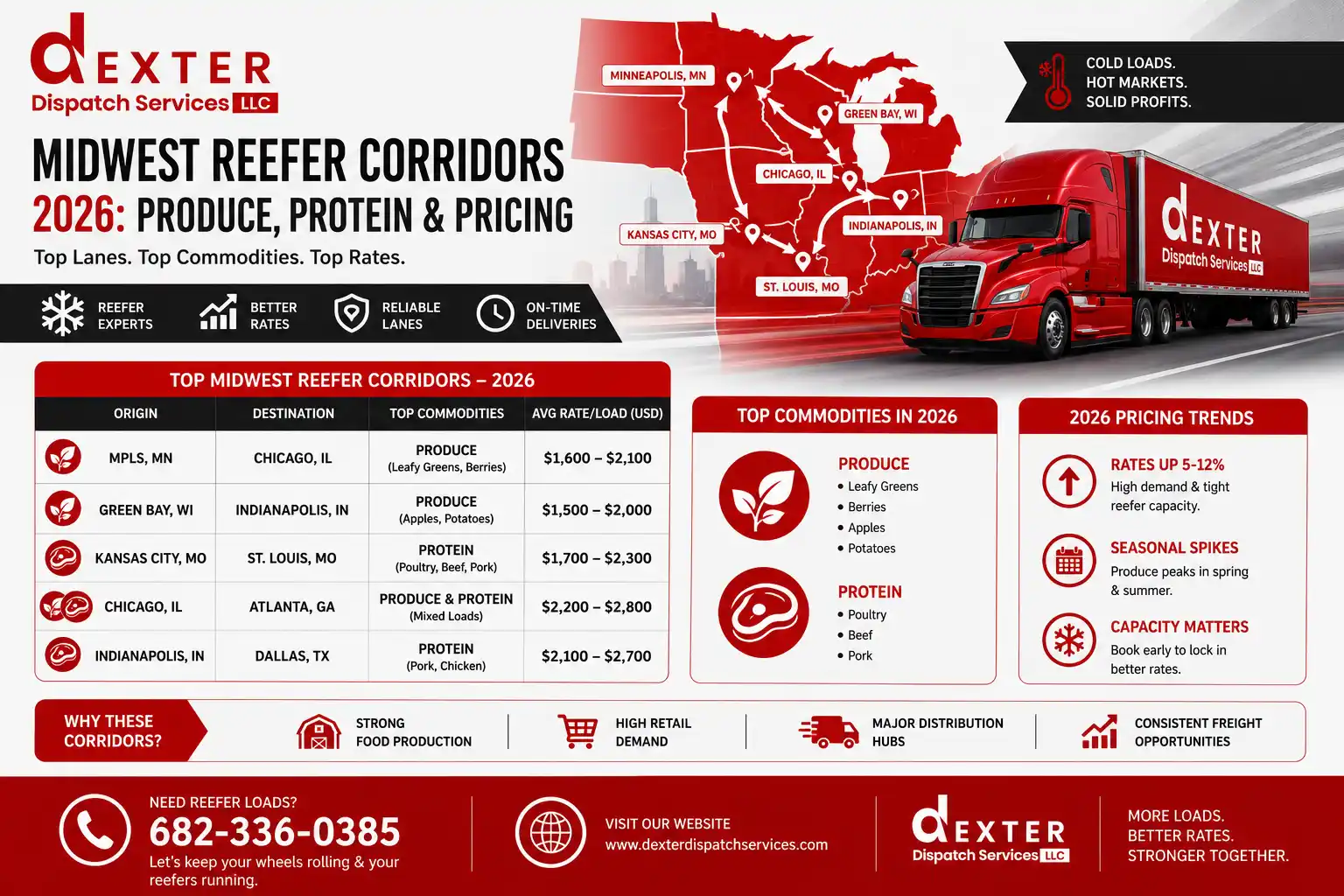
Reefer pays better than dry van” is the part of the math the rate sheet shows
The “rate” is one column. The rest of the columns move when the trailer is a reefer. The reefer unit’s fuel burn is an additional $35-$60 per day while on the truck’s settlement and not absorbed in the rate. Most loads have a pre-cool time of 30-90 minutes. Detention claims are frequently disputed when it is the broker who has claimed that the temperature is not adhered to, but there are a few reasons why detention does not begin as soon as it should.
| Midwest corridor | Produce season | Protein season |
|---|---|---|
| Chicago hub | Spring-Fall | Year-round |
| Kansas City | Summer | Heavy in winter |
| Indianapolis | Mixed | Mixed |
One product damage claim is $20,000 to $60,000 for a 40,000 lb load of frozen produce for a temp out of range claim. Deductibles pay a significant bite, the insurance pays some and the carrier’s premium increases on the next renewal. You can do some reefer math at the load stage. Reefer math at the quarter level will hinge on the uptick of any of those claim events landing.
The Midwest corridors where reefer actually books
The majority of the Midwest produces protein and dairy, which are worth running moves on three reefer corridors. They act differently, and the operator’s discipline must be different, too.
- Chicago / Indianapolis hub. Mixed pickup volume with high broker concentration and a lot of produce coming in from the West Coast and Mexico for redistribution. Dock appointments tight. The detention pattern is not good. Two-hour holds in Chicago are routine, and on the reefer here, fuel burn continues to increase during the wait. Claim discipline is high with products moving through the cross-docks, where temperature controls are taken at every product change.
- NEP-ENER: Non-Exportable Energy Resources and their Markets (Kansas City / St. Louis Protein Corridor). Beef and Pork plants in the KC region are moving east and south. Loads are more intense in weight and lower in volume. Typically, rejection risk due to temperature exists in these plant-direct receivers. The window of detention is slimmer, and there’s a requirement for protein receivers to keep things in the cold chain, making holds costly on both ends. There is a premium, but the equipment needs to be snug.
- Minnesota / Wisconsin dairy. Class A / Class B dairy products, more frequent shorter hauls, and bigger seasonal variations. The reason for that is that Winter has a lower load on the reefer due to the surrounding air temperatures. Summer: when it is hot, it is hot; assignments for fuel started to increase, claims increased, and even dockside reefer audits became the norm. Operators who fill this corridor in summer and Ride in the Winter.
Every corridor is reloaded in a different pattern, utilizes a different Broker-book, and has its own unique classroom for a specific piece of equipment. That’s why operators end up treating them as one Midwest reefer market and ensuring that at the receiver, they are running warm on the frozen produce load and cold on their dairy load.
The temperature discipline that separates reefer that pays from reefer that bleeds
The temperature log is crucial to claim defense for a reefer. Repeat logging (can be downloaded in PDF format) for those times (bol times). Generally, reefer units manufactured after the year 2018 have this inbuilt capability. The operator’s task is to physically move the log on every load, save it in a file folder with the load number, and make it available 3 weeks later when a broker calls with a temperature inquiry.
Pre-cool discipline matters. Initial setup 30-60 minutes in advance of the load, and make sure the trailer is at the desired temperature before opening the doors, and not taking a load that arrives on a warm trailer. These thirty minutes at pick-up are what get the claim three weeks later.
The other is the door opening time. When the doors are open at a dock while the unit is in operation, fuel burns and ambient air enter the box every minute. They are operators who try to minimize the time that the doors are open, who oppose receivers pushing open-door unloads, and who document the conditions when the door-open time is more than the amount dictated by the dock standard in order for the reefer to run.
Reefer detention doesn’t flow evenly down a corridor. Review the last twenty loads and see where they actually took place. Typically, it’s two or three shippers, not the lane.
Where the reefer premium disappears
For those operators who don’t practice temperature discipline, the reefer premium evaporates the quickest. A board reading $2.85 RPM will appear to be a good run from Chicago to Atlanta, but when a $32 thousand claim comes in, and it is impossible to pull the tem-log to defend on documentation, it is time to look at the board. It can convert a quarter of clean revenue to negative revenue.
It also goes away on operators who are using old equipment with a reefer. Be sure to claim one that has a logging problem or temporary setpoint drift, or the door seal is leaking, and is using a reefer unit. The maintenance expense for a reefer trailer is $4,000-$8,000 a year in addition to the truck maintenance cost, and that is where the premium becomes a loss.
The third location of the premium being lost in detention. Produce and protein receivers are consistently working 2 or 3-hour dock holds. On dry van – this is lost time. On reefer, that adds up to lost time, fuel consumption, plus claim exposure (load in temp ambiguity rejection). The dollar value of the detention cases, but a higher percentage would be difficult to collect when the broker has a greater incentive in attempting to dispute a detention case.
Where the corridor still pays
The best operators in the Midwest run a clean Midwest reefer, newest trailer, continuous logging, with the broker book on the inside tight, pull RPM’s in the $2.65-$3.10 range year-round, with summer pulling strong, winter softening. The reefed operating cost, above the reefed fuel, maintenance reserve, and claim risk premium, is $400-$700 per week, more expensive than the dry van equivalent at the same corridor.
That delta is real. It’s also earned. When the dry van owner reviews reefer rates and doesn’t convert discipline, he or she lands in a worse net in two quarters’ time.
Where a dispatcher matters more on reefer than on dry van
It is more difficult to dispatch a reefer. Cold trailers should not be left empty for long, and thus, the windows are shorter. There is more argument about follow-up for detention. Claim exposure involves the desk being aware of which brokers simply pay rejected loads and which ones battle every temperature ambiguity to the mediation table.
A dispatch desk that has a Midland reefer should be able to identify three brokers along the three corridors who pay detention right on time, two who have the best hand in fighting claims, and one that really screws over new carriers on temps where there hasn’t been a bit of a discussion. That’s the point with the broker, and the reefer corridor fee typically clears its line since the call to reject on which broker is worth a lot more to the desk than the fee/week.
A reoffer week in the Midwest should include an RPM over $2.65, less than 10% deadheads, all detentions written up for whatever reason for the detention the operator thinks the broker will pay, all temperature logs being submitted on the load number, so that they can be submitted by the loading station, and a desk that knows which dock to call first at the end of the week on Monday morning. Anything below that line is the equipment’s own corridor problem that isn’t corrected on its own.
Conclusion
The Midwest reefer corridors in 2026 remain highly important for moving produce and protein across the U.S. Seasonal demand, fuel costs, freight volume, and regional supply all continue to impact pricing. For carriers and owner-operators, understanding these market shifts helps secure better-paying loads, reduce deadhead miles, and improve overall profitability in the competitive refrigerated freight market.
👉 Contact Dexter Dispatch Services at www.dexterdispatchservices.com or call us at [682-336-0385]