
A multifunction stack trailer provides the functionality of carrying a wide variety of goods. With this indispensable tool, your business can now have the flexibility to move anything from household essentials to food and beverage items to everything in between. When the pallet loads are packed and shipped by using a dry van trailer, not only does it ensure safe transit of goods but also proves to be a cost-effective solution for dry van loads.
No matter the nature or volume of your cargo, planning and understanding dry van logistics are key to the efficiency of your dry van freight transportation. This article goes into detail about the capacity of a 53-foot trailer, the number of pallets, and tips on maximising your dry van freight shipment for a smooth execution, in light of dry van size and dry van height.
What Are The Dimensions of A 53-Foot Trailer?
What sizes are used in trailers and the shipping industry? While some companies have chosen to use 48-foot trailers, most prefer the 53-foot option to load pallets on trucks. These 53-foot trailers are ideal when it comes to transporting a number of pallets. American highways frequently display these trailers;
In order to determine the dimensions of these trailers, it’s important to take into account the following factors:
Height: The maximum height of cargo for a trailer of this size is usually somewhere between 108 and 110 inches, which is equivalent to nine feet to nine feet, two inches. Provided a height of 108 inches normally seen
Width: The complete cargo width capacity typically ranges from 98 to 100 inches, or eight feet two inches to eight feet four inches. One hundred inches is the width measurement.
Length: The maximum length goes to a maximum of 53 feet or 636 inches.
Weight: The general range of weight capacity is 42,000 to 45,000 pounds. This range can vary based on the specific trailer and the goods it is transporting.
It’s worth noting that items that are bigger in dimension than this cannot be delivered, as they won’t be able to fit securely on a truck bed. If you have freight that is too big, too heavy, or difficult to properly and safely load onto a truck, it’s all about planning the shipment properly prior to being picked up (load requirements, etc.); securement expectations; realistic time to deliver, etc.
Loading Pallets: Four Methods for Utilizing a 53-Foot Trailer
The demand for dry van trailer space and semi-trailer pallet capacity has increased substantially recently, but the supply has not kept pace. Without proper planning for pallet loading and shipment, there’s the possibility of paying too much. Securing an appropriate dry van to meet your requirements is a challenge and won’t be getting easier any time soon.
However, there are a few tricks you can use to ensure the best possible use of space on a trailer, mostly around different pallet loading methods. The size and weight of the pallets used determine the success of these strategies. Let’s examine these tactics in more detail.
Straight Pallet Load
The number of pallets that can be accommodated directly in a 53-foot trailer will depend upon whether you’re going to be dealing with standard-sized pallets. In this type of situation it is a good idea to use a straight loading pattern, which is the most common way to make the space on a trailer as large as possible. With this method goods are put into the trailer itself, and there is much space left for securing the pallets.
The major plus of using a straight pallet loading pattern lies in its efficiency – it is the fastest method out of all other techniques. In addition, depending on the length of each pallet, a large number of pallets can be simultaneously loaded for mass shipments. However, a possible downside of the straight pallet load is that there’s an increased possibility of movement of the pallet in transit.
Turned Load for 53-Foot Trailer
For loading non-standard-sized pallets, the use of a turned pattern is recommended for freight loading. By arranging pallets in a manner that allows the longest side to use up as much space as possible, you may be able to get a higher volume of deliveries.
The main benefit of changing the pallets lengthwise is the decrease in shifting that occurs during transit, which offers security for the goods. However, it’s very important to ensure safe unloading on both sides with this strategy.
Pinwheel Load
When you’re looking to pack a lot of stuff into your shipment, it’s a good idea to use a pinwheel pallet pattern. This method allows you to pack in as many pallets as possible, making the most of the width and length of the trailers. Along with arranging the pallets, it will also help in improving the stability while in transit in this pattern. However, it’s important to note that setting up pinwheel pallets can take time, making this not a practical option when dealing with shipments with short notice.
Weight Distribution Freight Load
It is illegal to ship by semiauto and trailer a load of more than 80,000 pounds. While this weight capacity may appear to be a lot, it includes the weight of both machinery and pallets.
As a general rule, a semi-tractor would range from 18,000 to 21,000 pounds, with a dry van trailer having 15,000 more pounds. Consequently, there’s little remaining room for additional semi-trailer pallet capacity. After subtracting these weights, there are about 44,000 to 47,000 pounds for palletised goods.
It is imperative to note that distributing the entire 47,000 pounds to the rear axles of a trailer is unsafe and makes it difficult for the truck to move around. Single-axle dry vans will have a capacity of about 20,000 pounds above the axle, whereas tandem-axle trailers have a capacity of 34,000 pounds. Depending on factors such as the number of axles, the distance between each other and the tyre width, weight distribution will differ.
Ultimately, for heavy palletised freight loads, more pallets can often not be hauled out of the spacing limitations.
Why Trailer Space Planning Matters (Beyond “Fitting More Pallets”)
Loading the dry van more is not all about making better use of dry van space; it’s about avoiding costly problems on the road.
Poor loading plans may result in:
- shifts cargo pallets, damaged and
- rejected loads at pickup or delivery
- delays and additional labour time and risk of detention
- weight distribution issues that cause safety relations
Even a simple loading plan can help keep your time, your equipment and your weekly profit safe.
What is the Maximum Number of Standard Size Pallets that can Fit in a 53-Foot Trailer?
The number of pallets that can be held on a 53-foot dry van trailer varies according to the sizes of the pallets that are being used. Dry vans are often used to transport a variety of palletised cargoes, which means that pallet lengths are inconsistent for freight shipping. However, let’s have a look at this scenario with the most prevalent pallet size.
The most widely used pallet is the Grocery Manufactuarers Association Pallet, or the GMA Pallet, 43 inches long by 40 inches wide. Designed using standards that meet the requirements of the food industry, these pallets are designed to withstand the dry van conditions. If loaded in a straight pattern, you can have 26 of these pallets on the floor of a dry van trailer.
For larger capacity pinwheel or turned pattern configurations, the totals vary from 28 to 30 pallets to be accommodated, allowing for more room within the confines of the trailer than for a straight loading pattern.
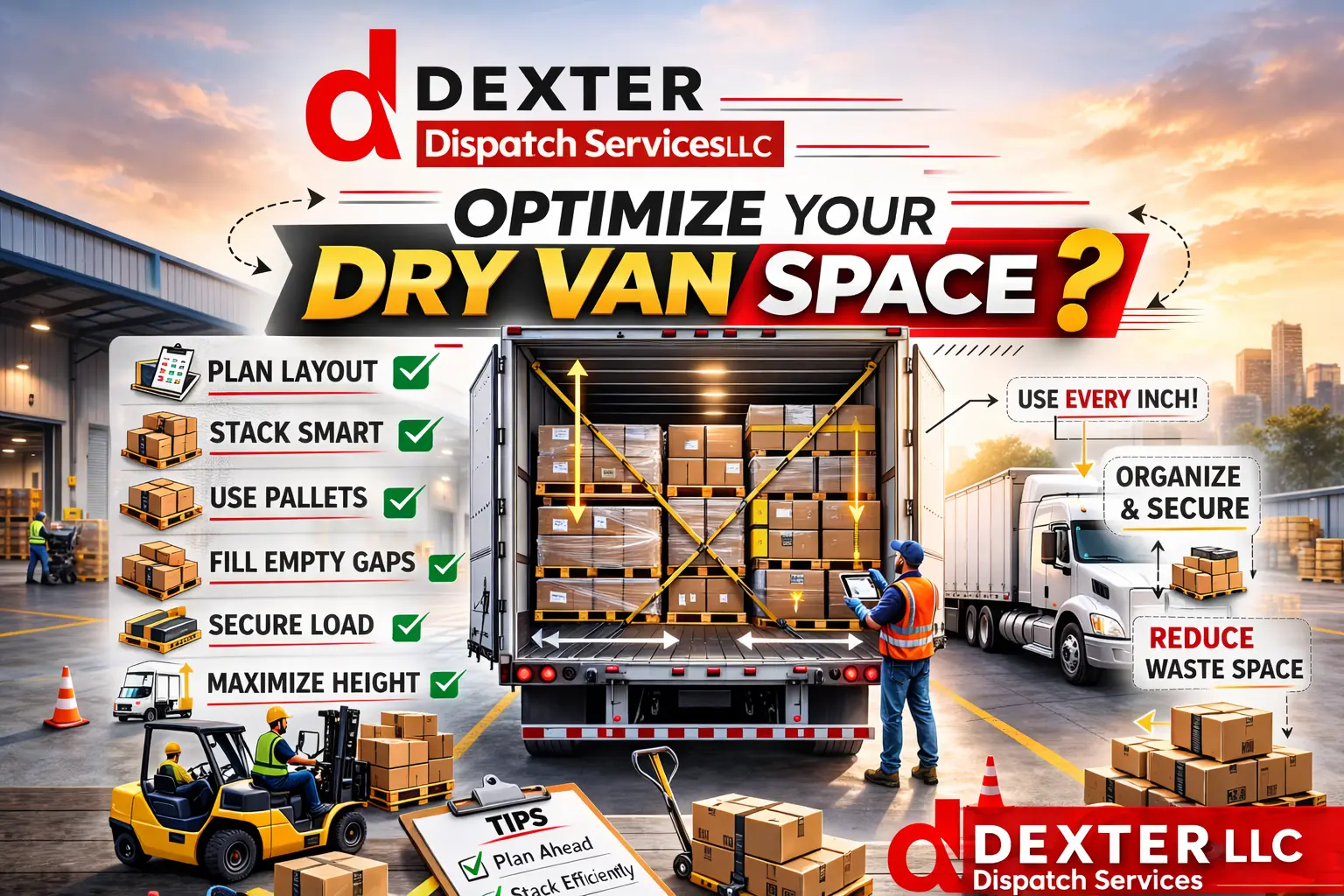
Before shipping, it’s important to have a pallet loading diagram ready in order to reduce costs and securely maximise the loading capacity.
Conclusion
Efficient utilisation of your dry van space is critical to a successful delivery, and thorough preparation is key, especially when it comes to dry load trucking. Loading your products safely and efficiently will ensure the process is smooth sailing. It’s important to plan your pallet diagram way ahead of time in order to have your pallets laid out in the most optimal pattern based on types of dry van trailers. Keep in mind that while a pinwheel pattern allows maximum space use, the time to load is more.
If you operate a dry van, smart loading and weight distribution are part of running profitable weeks– because they have an impact on downtime, delivery performance, and smoothness of load.
For owner-operators and small fleets, Dexter Dispatch Services offers load planning and dispatch support so that you can drive cleaner routes, circumnavigate preventable issues, and not worry about anything else besides driving.
👉 Contact Dexter Dispatch Services at www.dexterdispatchservices.com or call us at [682-336-0385]