
The common thing that we hear from business people is what is the weight that the truck can handle? While it would seem like a straightforward question, at least for the fall of 2026, that answer is a little trickier.
When it comes to safe and legal carrying capacity, the answer is not as straightforward, with a few factors to consider. We also take into account if the products need to be protected from the weather or if there is a need for a certain temperature. Selecting the appropriate one is essential in ensuring safe end-to-end transport.
| Type of Truck | Purpose/Uses | Max Weight Capacity |
|---|---|---|
| Box | Hauling large items such as appliances and furniture | 26,000 pounds |
| Flatbed | Transporting heavy loads not compromised by bad weather or rough roads | 48,000 pounds |
| Dry Van | Fully enclosed semi-trailer used to carry palletized, boxed, or loose freight | 45,000 pounds |
| Step Deck/Drop Deck | Commercial trailer for hauling tall cargo exceeding legal height limit for a traditional flatbed | 48,000 pounds |
| Reefer | A refrigerated/heated trailer used to transport cold or hot items | 45,000 pounds |
| Hotshot | Class 3, 4, or 5s pulling a flatbed or other trailer for extra capacity | 16,500 pounds |
Weight Capacity
Figuring out rules and regulations involving truck load capacity can be confusing. When dispatching haulers to particular loads, our dispatchers look at a number of factors. One of the concerns when carrying loads in the coming autumn of 2026 is federal regulations.
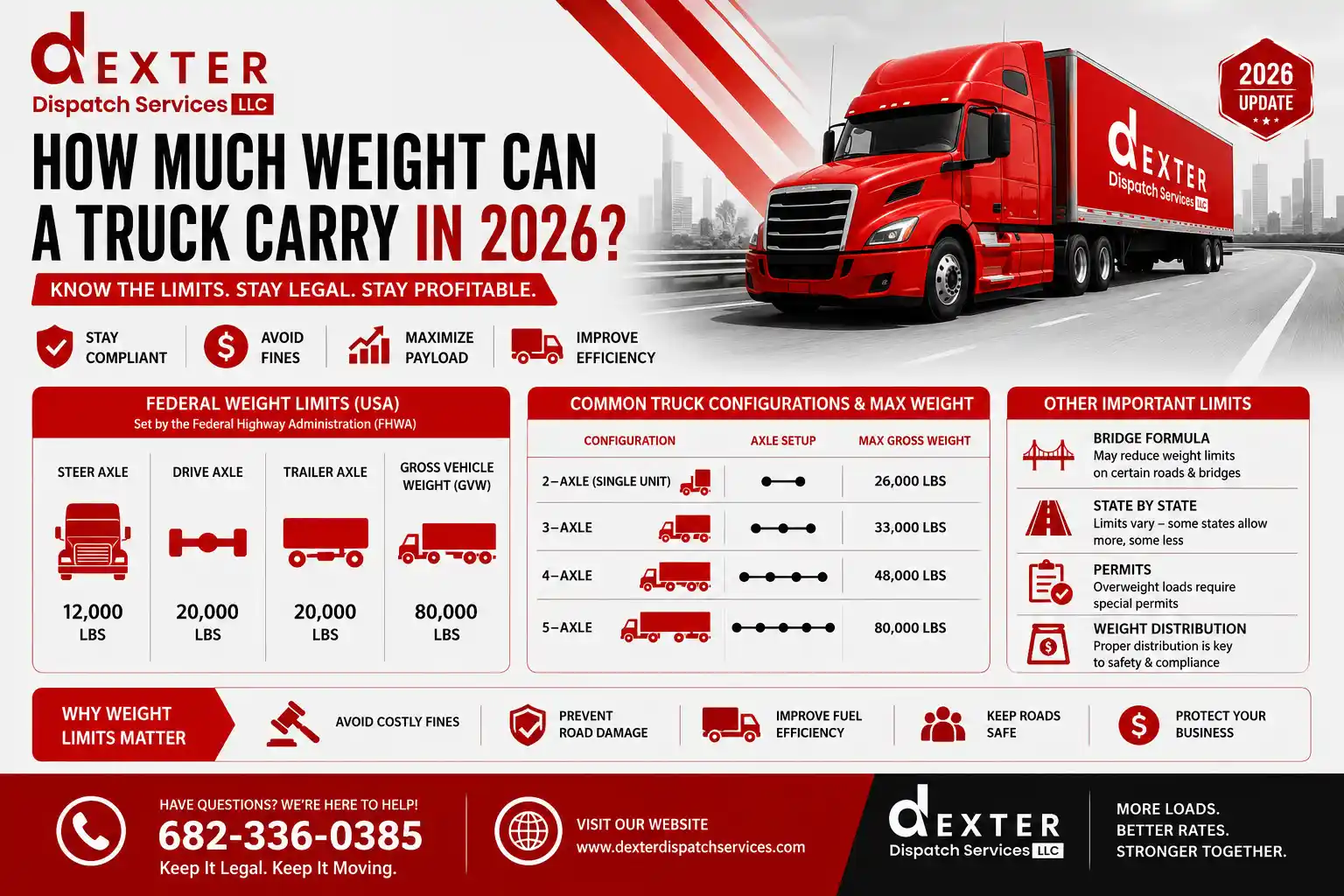
The payload capacity is the amount that a truck can carry. This is the weight that can be placed in the truck in addition to the empty truck. An empty semi-truck with a trailer will weigh from 14,000 to 16,000 pounds. The Gross Combined Weight Rating (GCWR) of this type of truck is limited to a maximum of 80,000 pounds, as per Federal limits. Each state has its own weight capacity guidelines, some states have higher load limits than the federal regulations.
Weight Classifications
Once upon a time, the terms half-ton, three-quarter-ton, and one-ton were there to make things simple in reference to the carrying capacity of a truck. As manufacturing gradually became more competitive, these became more of a guideline for what the truck could achieve than a literal indication.
I think payload specs eventually became known as titles that determined truck size relative to each other. The modern-day vehicle may well break these initial weight limits. Traditionally, the 1/2 ton truck has a capacity of up to 1000 lbs, the three-quarter-ton pickup up to 1500 lbs, and the one-ton pickup up to 2000 lbs. Since then, these maximum capacities have been cut back.
Trucks could also certainly be split among light-duty, medium-duty, and heavy-duty trucks. These can be further broken down to ranges, like a half-ton, etc. This may offer you a basic notion of how much you can carry, but you should keep in mind that this is merely a guideline and not a hard and fast rule.
Light-Duty Trucks
The American Transportation Research Institute (ATRI) defines a light-duty truck as one with a gross vehicle weight rating (GVWR) under 10,000 pounds, which is considered by the Federal Highway Administration (FHWA) to be the most common weight for light trucks. The following trucks are not considered: 6 or more tires; more than 2 axles.
MOVES, commonly referred to as the Motor Vehicle Pollution Simulator, assigns classifications to light-duty vehicles based on federal emission control requirements. According to this classification, light-duty vehicles have a gross vehicle weight capacity (GVWR) of up to 8,500 pounds, independent of their FHWA rating. This may also be observed in the class ratings. Most likely, this is the classification most people are familiar with because this is the classification vehicle manufacturers will use when they classify a light-duty truck as a “half-ton truck.
Just so you know, there are two classes of light-duty trucks – Class 1 (less than 6,000 GVWR) and Class 2 (less than 10,000 GVWR).
Class 2 itself is divided into Class 2A (autos 6,001-8,500 lbs.) and Class 2B (autos 8,501-10,000 lbs.). Any trucks that fall into the class 2A range may also be known as light-duty trucks, and trucks included in the class 2B range may often be called light heavy-duty trucks.
These two cases show where the vehicles now exceed the criteria used to classify the vehicles in the past. Today, a half-ton pickup can carry over a ton of load, depending on the make and model. By comparison, a midsize pickup truck can, without difficulty, carry half a ton (1000 lbs), and some can even carry 750 lbs.
Medium-Duty Trucks
Medium-duty vehicles can be categorized in many ways. These types of cars are typically utilized in employment or trade/professional conditions. They are the ones that are meant to transport larger weights than the others. This classification is not used very frequently in the transportation and logistics industry. Although most medium-duty trucks are used for commercial applications, there are still some left on the road that are not for commerce.
The GVWR may vary from 10,001 to 20,000 pounds. to 26,000-lbs. Here are some examples of the different types of medium-duty vehicles.
Heavy-Duty Trucks
Heavy-duty trucks range from trucks with a GVWR of 26001 lbs or higher. These cars will be For Business purposes. These kinds of vehicles include vehicles used for the transportation of dry vans or refrigerated trailers, such as trucks, dump vehicles, cement mixers, utility trucks, and tractor trucks. You’ll need to have a commercial driver’s license if you would like to drive any of these vehicles.
Do I Need A Commercial License To Drive A Semi-Truck?
You will be reluctant to decide if you need to obtain your CDL or not, considering the gross vehicle weight rating (GVWR) of the trailer, the gross vehicle weight rating (GVWR) of the truck, and the gross vehicle weight rating (GVWR) of the truck and trailer. You will need a commercial driver’s license (CDL) if the GVWR of the trailer is 10,001 lbs. or greater AND the GVWR of the vehicle and trailer combination is 26,001 lbs. or greater. This includes both regular and pick-up trucks with the capability to pull trailers.
Despite this, there are certain ways to get around the DOT’s restrictions. This includes farmers, certain military drivers, and motorized construction equipment drivers who drive off-road for their businesses and meet requirements. It’s not, however, an exhaustive list.
For instance, if the car is registered as a farm vehicle, you, your family, and your farm staff may use the car within the state in which your farm is located or within 150 miles of the state in which your Farm is located. If the semi-truck was being used for business or if it was heading out of town (more than 150 miles), you would be expected to get a CDL. For more and more specific information on applicability, please visit FMCSA’s website.
What is a box truck’s weight capacity?
Box trucks come in a variety of sizes, all of which have the box shape. They’re perfect for smaller shipments of products that need to be shielded from the elements. Furniture and appliances fit in a box truck well, as do perishable foodstuffs and so on. They are most often used as a cost-effective logistics option for less-than-truckload (LTL) freight. Usually, cabins for most box trucks are separated from the cargo area, and some new ones even come equipped with a door separating the cabin and the load.
One important consideration in choosing the correct box truck is its weight capacity. The box truck’s maximum weight limit is 26000lbs. The size also plays a role. Box trucks are available in sizes of 10-26 feet.
How Much Weight Can a Flatbed Carry?
A flatbed truck is just as you’d suppose, a flatbed truck. It’s a flat-truck big transport vehicle. It doesn’t have sides or a top to keep its cargo from the elements.
When you have to get a moving company to transport heavy loads, which will not be damaged by any rough roads or bad weather, you should pick a flatbed truck. The beds not being enclosed make them ideal for items which are too large with doors and sides for trucks to carry. They are versatile, which makes them a great choice for transporting cargo that is 48 to 53 feet long, 8.5 feet wide, and 8.5 feet tall. The flatbed truck capacity and weight are 48,000 pounds.
Step Deck Weight Capacity
These commercial trailers—some people refer to them as drop decks—are useful for the transport of tall cargo that is over the legal load height of a standard flatbed truck. They are 48 to 53 feet long and have a bottom and top deck. It’s an 8.5-foot-wide step deck trailer and has a legal freight height of 10 feet and a weight capacity of 48,000 lb.
How Much Weight Can a Reefer Carry?
Refrigerated trailers and reefers are temperature controlled and are used to transport items that have to be kept at a cool or hot temperature. These are more often used with chilled or frozen products rather than with a warm product. Reefer’s interior can be switched based on the exterior air outside. In terms of size, their trailers are equal to other truck trailers, such as flatbeds and dry vans, which equate to 48 to 53 ft. long. Maximum width is 8.2 feet, and the maximum height is 8 feet. Between 42,000 and 45,000 pounds is the max payload.
Knowing refrigerated transport operation is crucial when using payload planning because of the extra equipment weight and compliance issues with transport refrigerators.
Max Weight Capacity on Hotshot
Hotshots are the most efficient choice for transporting cargo that requires 40+ feet of deck space. They are attached to class 3, 4, or 5 trucks that are towing a flatbed or other type of trailer for extra carrying capacity. Most of the time, they are used for a less-than-truckload (LTL) shipment. The pickup truck’s maximum weight capacity is up to 16,500 pounds.
Conclusion
The capability expressed in pounds is only part of the load story revealed in the federally mandated weight or capacity classes found on a vehicle. The actual amount of what will fit in a truck is determined by the type of truck, the axles, the kind of trailer, and federal and state regulations. When operators leverage compatible equipment for their freight, they minimize violations, secure long-term efficiencies, and lower risk.
👉 Contact Dexter Dispatch Services at www.dexterdispatchservices.com or call us at [682-336-0385]