
One of the most critical choices you will have to make when considering becoming an owner-operator or growing your trucking business is whether or not to invest in hotshot trucking or semi-truck trucking. Both can be profitable, with one main difference between the two: startup costs, operating costs, freight types, and profits.
Semi trucks may be able to carry a larger load and make a higher gross revenue. Hotshot trucking can be appealing to truck drivers who need a lower start-up fee and more flexibility. Which is the more lucrative choice is determined by your business objectives, budget, and the sort of goods you’re looking to carry.
This guide will undergo a comparison of hotshot trucking vs semi trucking and determine which business is better suited for a high ROI in 2026.
What Is Hotshot Trucking?
Hotshot trucking is the term used to describe the transport services that move smaller and time-critical loads and are typically performed with a heavy-duty pickup truck, flatbed, or goose-neck trailer. These loads are typically picked up straight from customers, without having to wait for a completed load.
Examples of hotshot freight are:
- Construction equipment
- Farm machinery
- Auto parts
- Oilfield supplies
- Building materials
- Industrial equipment
People who own and operate hotshot trucks find them to be a popular trend, as they do not need as much gear as someone who operates a semi truck.
What Is Semi Trucking?
Semi trucking refers to the transportation of full truck load (FTL) or less than truck load (LTL) goods, whether travel is local, regional, or long haul, with the help of Class 8 Semis and commercial trailers.
Semi trucks can carry all sorts of cargo, such as:
- Consumer goods
- Refrigerated products
- Dry van freight
- Flatbed freight
- Heavy machinery
- Retail shipments
Due to their capacity for carrying more weight, semi trucks play a crucial role in the freight industry in the United States.
Startup Costs
One of the biggest differences between the two business models is the initial investment.
Hotshot Trucking
There are a few basic requirements for starting a hotshot operation:
- Heavy-duty pickup truck
- A goose neck/flatbed trailer can be used for transportation, if possible.
- Commercial insurance
- Business registration
- Basic operating equipment
Many new owner operators will find that start-up expenses are significantly less than the cost of buying a semi truck and trailer.
Semi Trucking
There is a much bigger investment you must make when operating a semi truck, which includes:
- Tractor
- Commercial trailer
- Higher insurance coverage
- Additional maintenance equipment
- Larger fuel budget
While start-up expenses are more expensive, semi trucks will also provide access to more lucrative freight opportunities.
Operating Costs
Operating expenses directly impact profitability.
Hotshot Trucking Costs
Typical expenses include:
- Fuel
- Truck maintenance
- Trailer maintenance
- Insurance
- Tires
- Dispatch services
- Permits
Heavy-duty pickup trucks generally cost less to maintain than Class 8 semi trucks.
Semi Trucking Costs
Semi truck operators often spend more on:
- Diesel fuel
- Tires
- Repairs
- Preventive maintenance
- Commercial insurance
- Parts replacement
Higher operating costs require careful financial management to remain profitable.
Revenue Potential
Revenue is where many people assume semi trucking always wins.
While semi trucks can generate significantly higher gross revenue because they haul larger loads, gross income doesn’t always equal higher profits.
Hotshot Trucking
Many hotshot drivers earn competitive income by hauling urgent freight with faster turnaround times. Success depends on finding consistent, well-paying loads and reducing empty miles.
Semi Trucking
Semi trucks often secure larger freight contracts and can generate higher weekly revenue. However, higher fuel, maintenance, insurance, and financing costs can reduce net profit.
The key is focusing on net income, not just gross revenue.
Flexibility
Hotshot trucking offers greater flexibility for many owner-operators.
Drivers often have more freedom to:
- Choose loads
- Select routes
- Schedule time off
- Work with multiple brokers
- Accept local or regional freight
Semi trucking may involve longer routes, stricter schedules, and more time away from home, depending on the type of operation.
Freight Availability
Freight demand in both industries is high.
Hotshot trucking is effective in industries that need swift deliveries, such as:
- Construction
- Agriculture
- Manufacturing
- Oil and gas
Semi trucking has the ability to serve the vast majority of industries and also provide access to an extensive portion of freight, such as dry van, reefer, flatbed, tanker, and specialized freight.
Maintenance Requirements
The price varies; the repair is a major issue for every commercial vehicle.
Hotshot Trucks
Typical service activities involve:
- Oil changes
- Brake inspections
- Tire replacement
- Suspension service
- Trailer maintenance
- Semi Trucks
Semi trucks require:
- Engine maintenance
- Transmission service
- Brake system repairs
- Air system inspections
- Multiple tire replacements
- Trailer maintenance
When semi trucks need repairs, they are typically costlier due to the equipment’s size and complexity.
Driver Lifestyle
Lifestyle is a big consideration, too.
Hotshot Trucking
A lot of hotshot operators like:
- Greater schedule flexibility
- More regional work
- Considering and providing more opportunities to return home;
- Faster deliveries
- Compact machinery, which is easier to manoeuvre
Semi Trucking
Semi truck drivers may be away from home for several days or weeks, depending on the job they are performing, particularly in long-haul trucking.
But fixed routes run through the region could offer more regular timetables.
Which Business Is Easier to Start?
Hotshot trucking is typically easier to get into for the new owner-operators because the equipment investment is less.
Often, many drivers will utilize the hotshot trucking industry to get experience before developing into larger commercial truck driving jobs.
How Dispatch Services Improve Profitability
No matter if you have a hotshot truck or a semi truck, dispatch support can help the process become more profitable.
Professional dispatchers help:
- Find quality freight
- Negotiate competitive rates
- Reduce empty miles
- Plan efficient routes
- Manage paperwork
- Coordinate appointments
It is important to bear in mind that many times the constant loading of your truck may be the deciding factor on your profits rather than picking one piece of equipment over another.
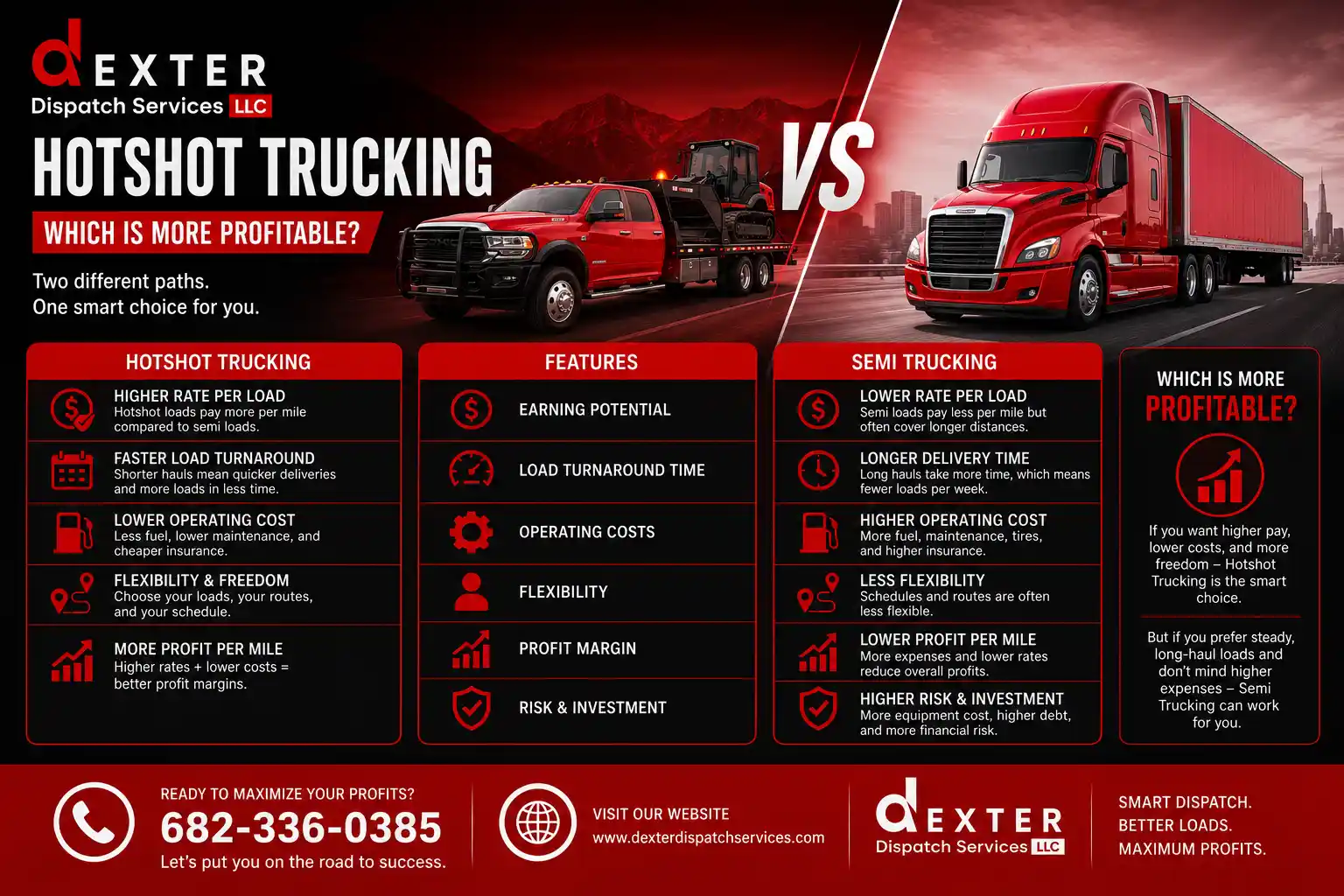
Which Is More Profitable?
This will vary based on your measure of profit.
If you: Hotshot trucking is the better choice if you:
- Want smaller start-up expenses
- Prefer flexibility
- Operate independently
- Focus on time-sensitive freight
- Looking for reduced costs of operation
You may be more profitable in semi trucking if you:
- Have sufficient capital
- Desire a larger volume of freight work
- Starting with a fleet in mind
- Is able to deal with increased operating expenses
- Arrive punctually and pick up the loads to drive.
Many owner-ops in both industries achieve high incomes by keeping their costs down, downtime to a minimum, and equipment rolling.
Conclusion
While both hotshot and semi trucking can be lucrative, the decision on which to pursue hinges on earnings, lifestyle, and objectives. With lower start-up costs, higher flexibility, and lower operating expenses, hotshot trucking can be a tempting choice for many new owner-operators. The other option is semi-trucking, which has the ability to produce a lot more income opportunities, but will call for a huge investment.
But don’t just look at the revenue, consider also the total operating costs, availability of freight, maintenance costs, and long-term business plans. Either of these business models can be a successful and profitable trucking operation, but this requires reliable equipment, sound financial planning, and a professional dispatch service.
👉 Contact Dexter Dispatch Services at www.dexterdispatchservices.com or call us at [682-336-0385]