

However, flatbed provides a higher rate than Van freight, and that’s where the thought of the majority of the owner operators stops. Higher rate, done. However, there’s not a single flatbed rate. It’s a base and a pile of accessorials that the work van freight never requested, and, yep, that’s where DIY booking loses money. The driver tears, secure, oversize route. He simply fails to charge for it. Even the load performs well. The settlement is just a little bit less than the work put in.
The Flatbed Rate Has a Ceiling. Most Operators Stop Below It.
What everyone quotes is linehaul. It is the accessorials that make all the difference between a booked and a paid rate. Tarping, additional straps and chains, oversize, multiple stop drops; they all count, they’re all billable. Many flatbeds are owner-operated and negotiate only the linehaul – somehow missing out on these accessorial revenues.
A broker is not going to give the tarp money where he takes the linehaul and postpones to see if you ask. The OO that never asks the tarps for a load for free, every time, and leaves the money he left on the table.
It is a recognised gap in this course. Accessorial/detention pay, for example, has always been identified by organizations such as the Owner-Operator Independent Drivers Association as another significant point at which owner-operators have been losing income, since it’s not always included in the settlement.
Visualize a steel load splitting from Gary. The base rate appears to be strong, and you opt for it. It must then be tarped, a permit must be obtained, and it has to be dropped again across town. You do all 3, since the goods need to be transported. But you quoted a number that you had on the phone, and it turned out the tarp, permit hours, and additional stop were your day and not the broker’s budget. No matter how nice that load was, it became one of the worst rates per hour without you knowing.
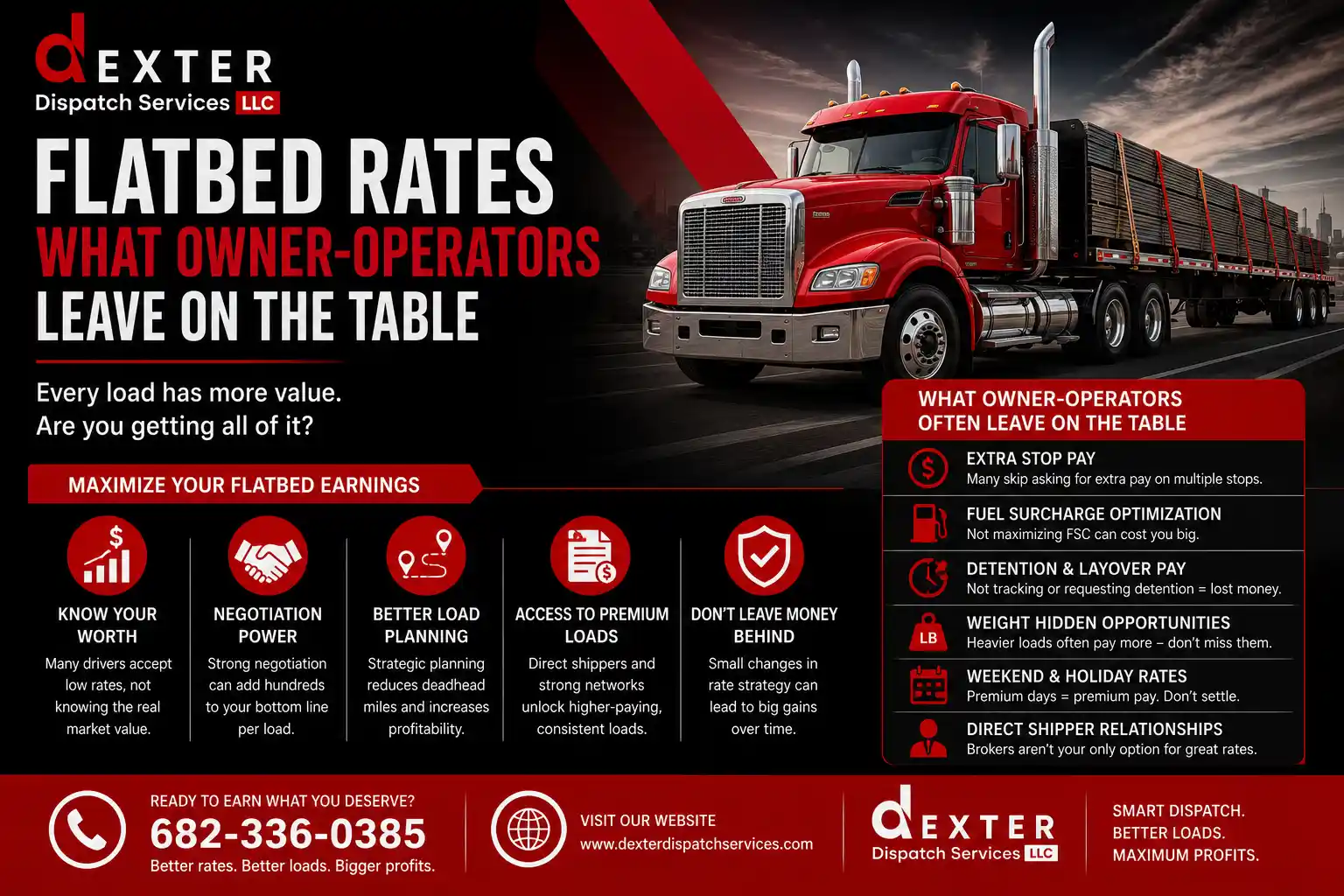
Why DIY Booking Underprices Flatbed
It’s not that the work doesn’t deserve the compensation, is it? It’s negotiating it whilst you’re loading and securing the freight as well!
After loads are taken, the broker gives a flat rate (non-sourced) rate, and it’s simpler to just point and say “yes” than to issue an itemised rate. So the tarp, the oversize permit time, the second stop- everything goes into one rate that seems really good — until you price the hours. When you book a flatbed freight service, remember that the owner operator who’s willing to accept a round number quote to do the job is not the one who will be willingly booking the job.
Solos also means the only two things that get you accessorial pay – the current lane rate, and time – are also negotiable. When a broker is aware of the market number, then he is aware of it “cold.” This is not a typical “at” conversation among an owner operator accepting a call at a truck stop; that means the driver argues down from a quote, not up. Since dispatchers are looking at several different broker offers throughout the day, it would be easier to note when a lane is under or over the market rather than taking the first number given.
Where the Flatbed Money Leaks
- Tarped free when there was no agreed-upon tarp pay.
- Oversize loads (taken at prevailing rates) – Permit & route time uncovered.
- Multi-stop drop pricing is a single delivery.
- Freight with a securement was equal to an easy strap-and-go.
- The reason for this was that you had no waiting terms when you took the detention in a slow mill or yard.
The cost of an unpaid tarp is small. That same window, a year of no flatbed loads, is a number that a truck owner-operator doesn’t want to see under his settlements.
What Common Flatbed Accessorials Actually Pay
| Accessorial | Typical pay | What it covers |
|---|---|---|
| Tarping | $50 to $150 | The time, the climb, and handling heavy tarps |
| Extra stop | $50 to $150 per stop | An added pickup or delivery and more securement checks |
| Oversize or overwidth | Varies by permit and route | Permits, routing, reduced speed, sometimes escorts |
| Detention | Hourly, usually after the free hours | Time lost waiting at a slow dock, mill, or yard |
| Heavy securement | Added to the linehaul | Extra chains, binders, corner protection, load checks |
These are typical ranges (not fixed) that move with the lane and the broker. It is not the exact number that is important. The fact that these are none of which favors. They’re line items, and the owner/operator who names them is paid for them.
What Rate Discipline Looks Like on Flatbed
Rate discipline isn’t holding out for a dream number. Before you say “yes”, they know exactly what you are being quoted for, in addition to the miles; it’s all on one bill.
It implies referencing tarving pay as a line, not as a favour. It implies that time on permit and route for oversize are covered prior to the roll of the load. It indicates the “LTC (light turn and chrome)” charge and the “Heavy securement. This is standard practice. A desk managing your week ought to be carried out on all flatbed loads; it shouldn’t be stuck under its cap. There are flatbed dispatch services running in the same discipline where all components of the load are priced.
That is the real case for Owner Operator dispatch: When an owner operator is running a one-person show, they’re backpacking, comparing broker offers, pricing accessorials, and providing the final rate confirmation is an encyclopedia of the job rather than just linehaul.
Flatbed Rate Questions Operators Actually Ask
Do I charge tarp pay as a separate charge and/or as part of the rate?
String it up as a line. When you build it, it hides it, and your new all-in number becomes your new baseline, and the next broker views it as that. The named tarps will stick to the load type and retain validity.
Is it really what brokers expect in terms of paying accessorials on flatbed?
The good ones do. Oversize and multi-stop are not unheard of cost drivers, as is tarping. If a broker refuses to pick up any of them, the rest of the relationship is going to be something like that.
How to maintain rate discipline while on the wheel?
Not between loads is when you do it from the cab. This is what full truck dispatch services do on your desk, before you agree to a rate for the job.
How to know if your flatbed rate is competitive?
Look at the linehaul and all of the anticipated accessorial charges before accepting the load. What may seem like an expensive flatbed on paper can feel quite average once the tarping, permits, detention, or additional stops are added to the time that the load takes.
The Check Worth Running This Week
Take out your last 10 flat bed loads and record each one requiring any of the following: Tarp, Oversize permit, Additional securement, or a second stop. Next, tally how much of that line item turned out to be “pay. Whatever work you have performed but not charged for is the ceiling you’ve been leaving on the table. All the difference isn’t a matter of bad fortune. It’s one type of money that is quite frequently recoverable just by charging for each and every aspect of the work before the truck moves.
👉 Contact Dexter Dispatch Services at www.dexterdispatchservices.com or call us at [682-336-0385]