

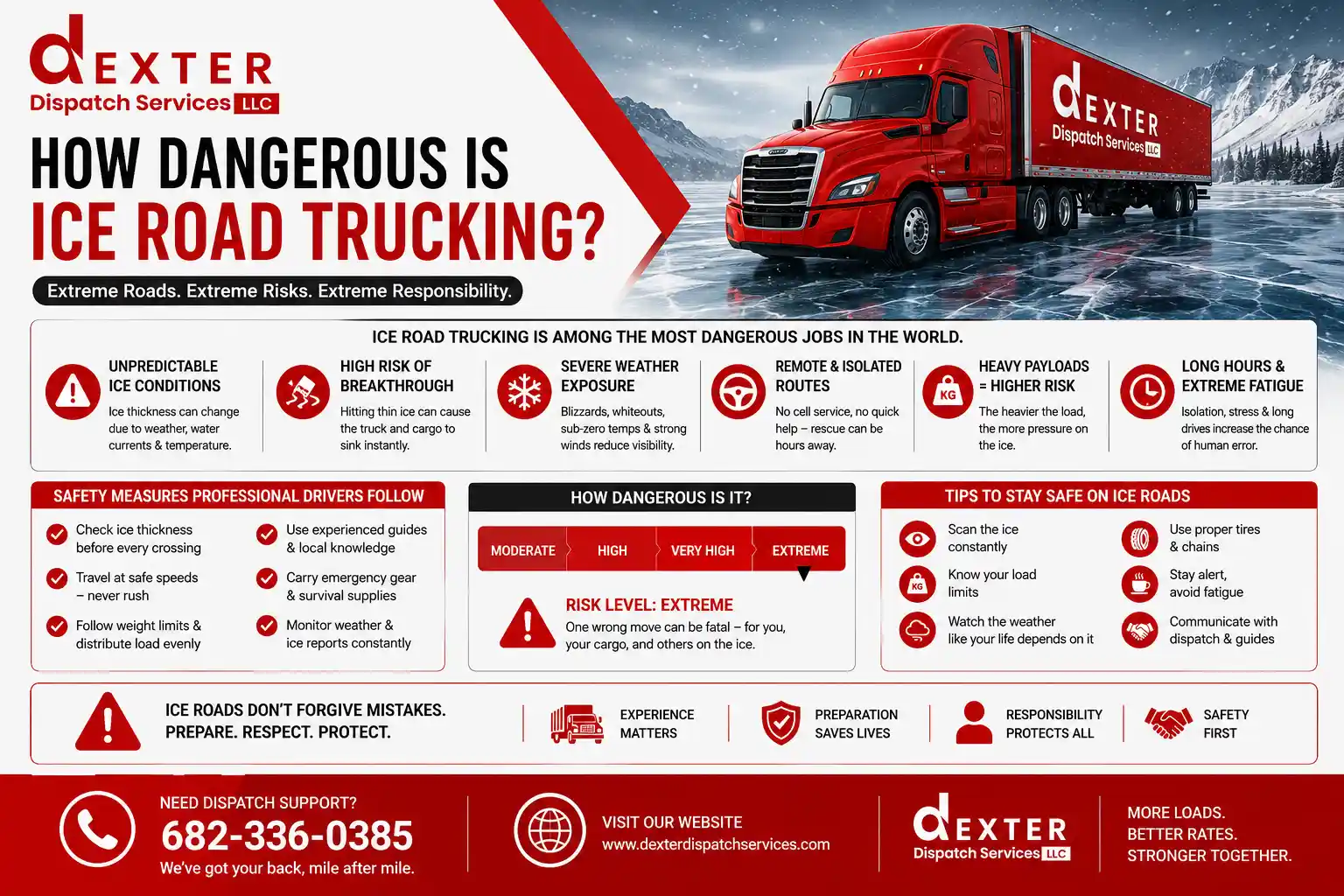
If you have ever seen an episode of Ice Road Truckers or the Netflix Original The Ice Road, you may think, “Does ice road trucking sound dangerous at all? The answer to that question is indeed “Yes!”. It can be dangerous for drivers and their loads. There are several potential misfortunes that can and do happen during these dangerous deliveries, from the cracks in the ice to the bad snowstorms, the breakdown of the truck, and/or low visibility.
Each time a trucker heads out on a run, they are aware of the dangers that are present in the midst of it. This is one of the reasons why ice road truckers make anywhere between $30k a month and $40k a month in just about 3 months of time. The job is quite hazardous, and they are among the professionals who are paid the highest salaries within the truck driving industry. They can make as much, or more, than other truckers in a few months that they would in a whole year. The season starts in January and stops mid-March.
What Is an Ice Road?
Every day, ice truckers drive on dangerous roads to do their work. What makes the routes so dangerous? First of all, they are not normal roads, and in North America, they actually are man-made, level areas of permafrost ranging from frozen river beds, lakes, and other frozen surfaces.
They can be found in some of the most remote and dangerous places in Alaska and the Northwest Territories in Canada. Routes in northern regions of the world that link two shores on any winter day are considered a fit for the definition. The top surface should not go below the waterline to support the weight of a heavy truckload. This is known as load-bearing capacity. An equation is applied to calculate the bearing capacity before trucks are allowed to cross one of these frozen-over water/carriers.
These dangerous routes are constructed each year. Heavy-duty specialized crews add layers of smoothness through the use of plows, radar, and water sprays. Completed, they will be able to support tractor-trailers and their load up to 100,000 lbs. The secret is to lift and move at the same time with heavy loads. These infrastructures have a capacity of just 60,000 pounds, but only so long as the truck isn’t in motion. That’s how much it’s a danger.
Is Ice Road Trucking Really that Dangerous?
Is an ice road trucker’s job really dangerous? Absolutely. Cold environment and harsh winter conditions lead to perilous driving conditions on routine roads. The fear and concern of hearing ice crack under your rig as you are driving only compounds the situation.
If the lakes, rivers, and other bodies of water freeze enough to support the weight of a tractor-trailer with its load, it is extremely cold! Northern Canada has the harshest winter weather with temperatures falling as low as -45 degrees Fahrenheit. With wind chill, it feels like -95.
Mechanical problems are possible in cold weather. If their trucks break down during a 400-mile journey, truckers run the risk of hypothermia. Not only does a sidelined rig freeze to death, but there are other problems as well. When not in motion, they’re designed to have a capacity of approximately 60,000 lbs. Too many things can go wrong for truck occupants when the truck comes to a rest.
Some other dangers truckers in this line of work face include:
- Accidents
- Avalanches
- Fractures
- Whiteouts
This type of job with a trucking company isn’t for everybody! Carriers that make these hazardous routes available to truckers are willing to provide specialty training to those who volunteer to take them on, such as winter driving routes or other hazardous route training.
Ice Road Truckers: Most Dangerous Roads
In the far North of Canada, more than 3,300 miles of roads are considered dangerous. Ice road truckers know the most dangerous roads can be found in Yellowknife, in Canada’s Northwest Territories. There are no roads that connect to the remote communities in the area of Yellowknife for most of the year, except by air or barge.
In Canada, during the colder months, truckers carve out their way through the marbled blue sheets of ice in remote locations such as Yellowknife to supply food, fuel, lumber, and other goods to the inhabitants in far-flung locations.
Ice road truckers’ potentially hazardous roads are:
- The Kuskokwim River in Alaska made history recently as one of the most dangerous and longest winter roads. From Tuntutuliak to Sleetmute, river hazards exist and make it dangerous for truckers to travel.
- Tibbitt to Contwoyto was first built in 1982 to service mines in the Northwest Territories and Nunavut in Canada. It is approximately 370 miles long, and 85 percent is constructed over frozen lakes. It actually was documented in 2007 by Ice Road Truckers, who made it clear that it was not a place for anyone else to go, and that’s because it’s extremely dangerous for the truckers who are used to making that trip up and down the roads during the season.
- Tuktoyaktuk in Canada was a southerly extension of the Dempster Highway and was the service point for Inuvik and Tuktoyaktuk. It was shut for the last time on April 29, 2017, when the work for the all-season road commenced. Once open, it was deemed to be one of the most unsafe roads.
- Wapusk Trail runs between Gillam, Manitoba, and Peawanuck, Ontario, in Canada. The 467-mile road is advertised as Canada’s longest seasonal winter road. The problem with the length is that conditions can change drastically from one end to the other.
Off-season Work for Winter Road Truckers
Chances are, after 2 to 3 months of sustained work that’s typical and expected in the seasonal trucking field, a seasonal trucker has options of what to do for the rest of their year. Some may look for other truck driving jobs, or some may opt to spend some time at home to compensate for the long periods away from home during peak season.
Job Outlook for Seasonal Truckers
Thus, there aren’t many employment opportunities for truckers, who specialize in such deliveries as they are quite perilous. Therefore, you can expect competitive pay. Also, truckers must be prepared to work in Alaska or Canada for months, as this work can only be found there in North America. Turnover can be high since some truckers are unable to detect or cope with the pressure of this kind of work. This provides new possibilities and an opportunity to take a shot at the perilous – and profitable – delivery routes.
Ice road trucking is sometimes likened to other kinds of specialized truck work, such as hotshot trucking.
It’s one of the harshest uses of commercial driving, with weather, isolation, and equipment reliability all combined and thrown at them. The people who drive under these circumstances typically have a number of years of experience in other demanding trucking jobs before becoming an ice road driver.
About Dexter Dispatch Services
We enable owner operators and small fleets to achieve more predictable weeks by streamlining their planning, picking the right lanes, and helping them with dispatch.
Conclusion
Additionally, Ice Road Trucking is one of the most dangerous trucking jobs that demands numerous qualities such as skill, patience, and concentration. Drivers are dealing with extremely cold conditions, slippery road surfaces, reduced visibility, and potentially dangerous ice conditions. They’re dangerous but reduced by proper training, safety rules, and route planning. If you’re a truck driver looking to work in the cold storage industry, it’s important to be aware of the challenges and take steps to prepare accordingly to ensure safety and success.
👉 Contact Dexter Dispatch Services at www.dexterdispatchservices.com or call us at [682-336-0385]