

When deciding on a dispatcher, most owner-operators take the costs into consideration, which is where the issue begins. It is not the percentage that counts, it is what percentage makes your dispatcher do!
If your dispatcher is on a per-load basis, then your week isn’t looking exactly the same to them. It’s all about cost per mile, positioning, and what’s next. They’re considering its next time-hired load. That difference is not about personal; it is part of the way they are paid.
In the business of dispatch, there are 3 main types of fees that influence the decisions made: chase higher-paying loads, chase a greater number of loads, or actually run the week.
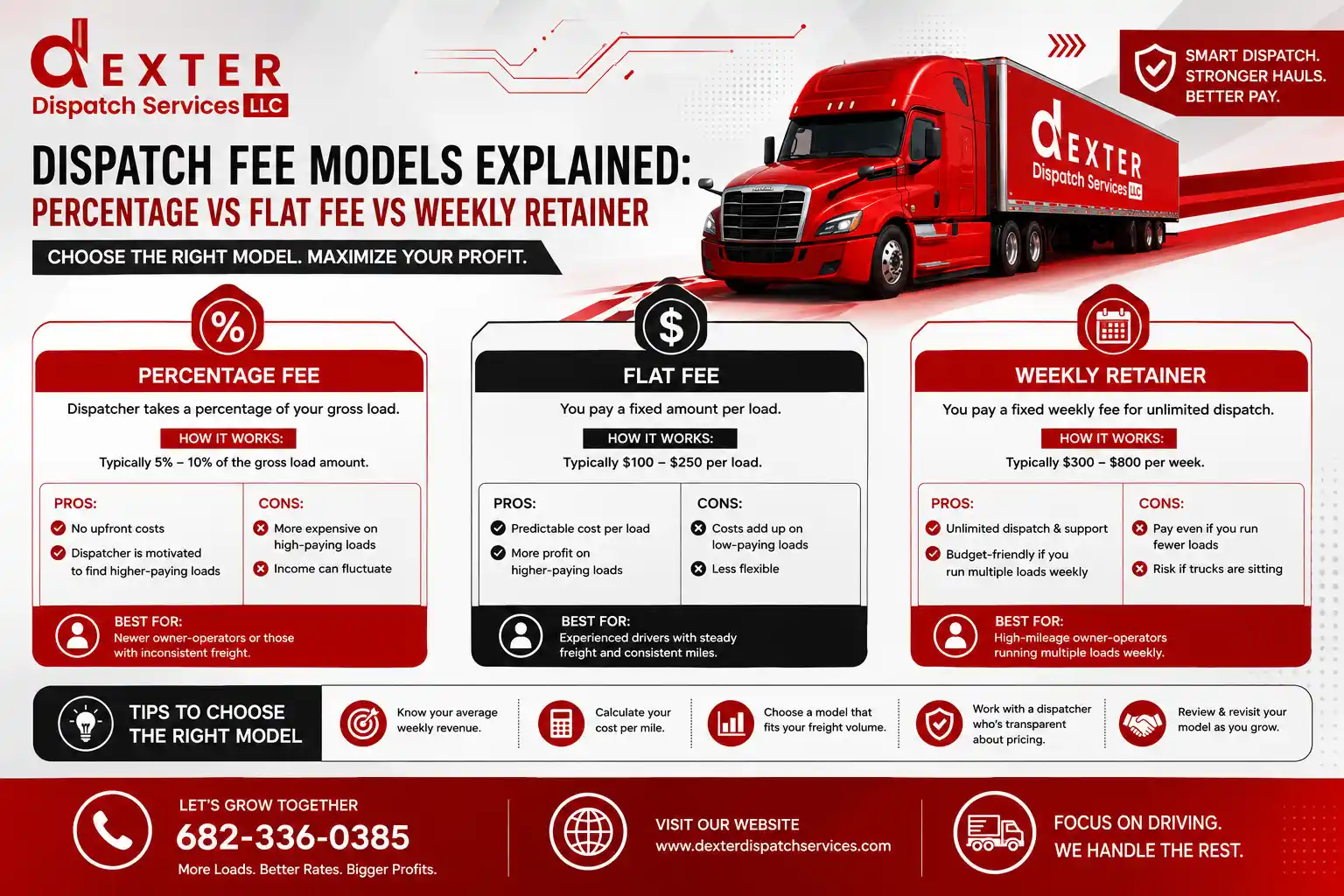
The Percentage Model Looks Aligned. That’s Where Operators Get Burned.
The most prevalent trucking dispatch structure is a percentage-driven model. A dispatcher is typically charged a percentage, somewhere between 5% to 12% of the gross money for each load loaded. The higher the payout a load receives, the more the dispatcher receives.
Doesn’t align on paper.
Let’s say you’ve already had at least a couple of good training sessions since Monday and Wednesday. 1200 miles away from home with a Thursday delivery. A commission-paid dispatcher may have some incentive to get you loaded on Friday, even if you’re going further out on that route – even if you might end up deadheading back on Sunday and killing your cost per mile for that week! Friday’s gross has the potential to be a favourable commission number. The deadhead doesn’t show up in it at all.
It’s not a character issue. This is a structural one. This is about revenue per load and not what happens to your week. None of that analysis applies to a dispatcher’s commission under this model, such as deadheading miles, detention time, or fuel costs as a percentage of your billable rate.
The Owner-Operator Independent Drivers Association (OOIDA) states that owner operators consistently cite managing total operating costs—not just their gross revenue—as their biggest issue in staying profitable. Gross load revenue-based fee does not do that.
The Flat Fee Model Looks Safer. Here’s Where It Breaks.
A fixed dollar amount is charged for each load booked under a flat fee dispatch service model, and is not dependent on gross revenue. The average range spans $50 to $150 per load, subject to various service levels, freight types, and markets.
This helps to solve the issue, but presents another.
Your dispatcher is not encouraged to pursue the load with the best rate, no matter how it affects the rest of the operation. If you book a $2,400 load, it doesn’t matter; if you book a $1800 load, that is the same fee. However, there’s still an issue with a flat fee per load – the dispatcher is paid per transaction. The higher the number of loads booked, the greater the amount of revenue they will earn. That represents, therefore, a tendency towards weak frequency rather than structure.
A flat fee dispatcher who books you four short loads in a week makes more money than a flat fee dispatcher who books you two good loads right in the middle of the week, which leaves you on a good schedule for the next week. If the operation is better off operating on two good loads as opposed to four broken up loads, the flat fee doesn’t pay the dispatcher for thinking that way.
Flat fee is a decent approach if your carrier operates a similar freight pattern, and lanes that benefit from volume are the key. It’s not yet aligned for owner operators who have to deal with positioning, to-and-fro home time, and varying weekly parameters.
Most Operators Skip the Retainer. That’s Exactly the Problem.
Retainer – The weekly retainer model is based on paying a set weekly retainer, not necessarily dependent on how many loads are booked up and what they gross. Whether the dispatcher books one or four loads, he or she makes the same amount of money.
This is the only model that changes the incentive. A dispatcher might be on a weekly retainer and has a lack of incentive to drive for more loads or to achieve higher gross numbers per booking. Their role, in fact, is to make your week happen; that could involve fewer loads, better positioning, stocking up and holding a load until you can find a better one, or disregarding a load that leaves on Thursday when it should really take up a load pool.
The weekly retainer model is still relatively new in the owner-operator dispatch world, in part because it entails a different type of dispatcher. It is not only a load broker but also a weekly planner. Now the dispatcher must consider himself as an operator, not only a book keeper. It involves spending some time to find out exactly what it costs to run your vehicle, how much time you spend at home, your fuel price rate, and how your every choice adds up to a week of driving.
That’s a trickier task to get right and one for which most per-load dispatchers will lack the detail they need about your operation. That’s the only model that encourages owner operators to think about the week, rather than just the booking they are about to take, however.
This is the fundamental distinction between a dispatch service for owner operators that works in terms of “weekly” results and a dispatch service for owner operators working through “per-load” transactions.
What Each Model Is Actually Optimizing For — and Why It Matters to Your Week
A fee structure is not only a pricing decision; it’s a statement of what the dispatcher thinks they do. It is important to go ahead and check out the pricing model as an indicator before you sign anything.
By having only percentage-based fees, a dispatcher will be based on load revenue. It is their unit of success! A dispatcher with a flat fee per load is transaction-based. Their unit of measure is volume. A weekly retainer is an organized dispatcher that cares about the outcomes — that means having the full context of your operation and making more difficult decisions.
As with any model, each steer’s decision is in a different direction. But, will that direction tell on your operation?
On a steady and busy operation, with regular lanes, a percentage or flat fees might be suitable. When your business uses one truck, different freight, different positioning, and different weekly goals, depending on the season, you need a dispatcher who can offer the same variety of incentives.
What Most Operators Ask — and the Questions That Actually Reveal the Problem
No matter what model a dispatcher provides, there are critical inquiries to make that provide insight into how he/she works in actuality. These are not gotcha questions – they are straightforward assessments of whether the dispatcher’s way of running the business will suit your needs.
- What about weeks when I don’t need as much? When a dispatcher in a percentage format doesn’t have a genuine answer, this may be a sign. Depending upon their rates, fewer loads equate to less revenue for them.
- How do you make position decisions? A dispatcher who is only involved with load booking might not have a system in place. Positioning is a weekly planning question – NOT load specific.
- When estimating the load, what factors do you consider with respect to deadhead? If they reply, “we try to keep it to a minimum,” press them for details as to the action taken to achieve that. The fee structure reflects, or otherwise, the analysis is not reflected.
- What information do you need me to provide you with concerning my operation? Asking you what you spend on your operation, what your target rate-per-mile is, what your home time needs are, and what your fuel costs are is signaling a different type of relationship than merely needing your MC# and freight type of preference.
- What happens when there is a disagreement that concerns a load decision? You want to make sure this dispatcher views themselves as coming up with the decisions for you or helping to make decisions that you make. That distinction matters.
Either the fees enable the correct analysis to be undertaken, or they don’t. Challenge to understand the ratio behind the rate.
Red Flag Language in Dispatch Fee Agreements — What It Costs You
In addition to the fee structure, there are some terms that are red flags in dispatch agreements. Watch for these:
- Percent on gross (no limit). If no cap exists, a dispatcher’s motivation will be to fill his/her dispatch books with high gross opportunities, without regard to price. Some loads can be really good on paper but bad in terms of fuel, tolls, and positioning.
- Freight only claims. The availability of loads is not managed by the dispatcher. If it suggests that they can access freight that no one else can, it is a sales gimmick, and not a service function.
- Old extended contracts, in which a player is subject to high exit fees on the original contract. A confidence-inducing dispatcher does not have to pinpoint you on the initial contract. If the exit penalties are high before you’re able to assess performance, that isn’t a good sign.
- Ambiguous usage of the concept and or criterion: “who controls” a decision on a load. In some agreements, there is wording that does indicate that it is the dispatcher’s choice as far as load acceptance.
- As an owner-operator, it’s always your choice whether or not to accept or reject freight. Any contract that muddies that should be looked at with care.
without the scope of services. What FEE is there really? negotiation paperwork, carrier packet management, check calling, rate confirmation? Ensure you have the scope in detail BEFORE any pricing structure is agreed to!
For a more comprehensive analysis of the downfalls of dispatching relationships from the beginning, the self-dispatch vs dispatch service comparison tackles the pros and cons facing most owner operators when considering whether or not a service is worthwhile.
The Cheapest Model Is Often the One That Costs You the Most
If that means the cheapest available is the most costly one this week, it is because it is! It is not only a percentage or a flat rate, but it’s also what that structure pays — and what it pays for versus what you need it to pay for.
A percentage-based fee isn’t bad; it’s struggling for something specific. Same with per-load flat fee. The question is “Is that optimization right for your operation?”
When your dispatcher is paid out of you based on loads, he or she is working at a different job than a dispatcher who is paid to help you run a better week. Your choice of model defines your dispatcher’s thought cap. Prior to accepting any pricing system, be sure to understand what the dispatcher is really trying to optimize for — and if it’s what you are looking to optimize for.
When your dispatcher is on a per-load system, this is the result you’ll continue to receive. It is that gap we developed Logity for.
Conclusion
Depending on your business size, load volume, and cash flow requirements, the accurate dispatch fee model can be selected from multiple choices. The variable cost that is measured in percentage may be applicable to the owner-type operators who would like to measure it against load revenue. The flat rate provides a fixed cost and is better suited for carriers who like stable costs per month. A weekly retainer fee is great for busy owner operators or small fleets with the need for full-time dispatch service and regular load management. No one-size-fits-all solution exists; it depends on your dispatcher and how valuable they are for your operation and your cost. When making an agreement, be sure to investigate various pricing models and select the one that will help to keep your profits growing.