

Service hire or W-2 hire. The Breakeven for most multi-truck operators is Not There.
You passed the second truck. Maybe the third. Now you see two numbers. Service charge on gross increase. A dispatcher’s salary line of your own. The first one expands as you get bigger. The second one appears to be set. That’s the trap.
Honestly, the comparison isn’t fee versus salary. It’s a payroll vs fee on the same gross with the same up on both sides. One model will place you in control. The other provides you with consistency with no overhead. If you select the incorrect one, then you pay either way. Dry van is one of the most common freight trailers used for safe, secure transportation of non-perishable goods.)
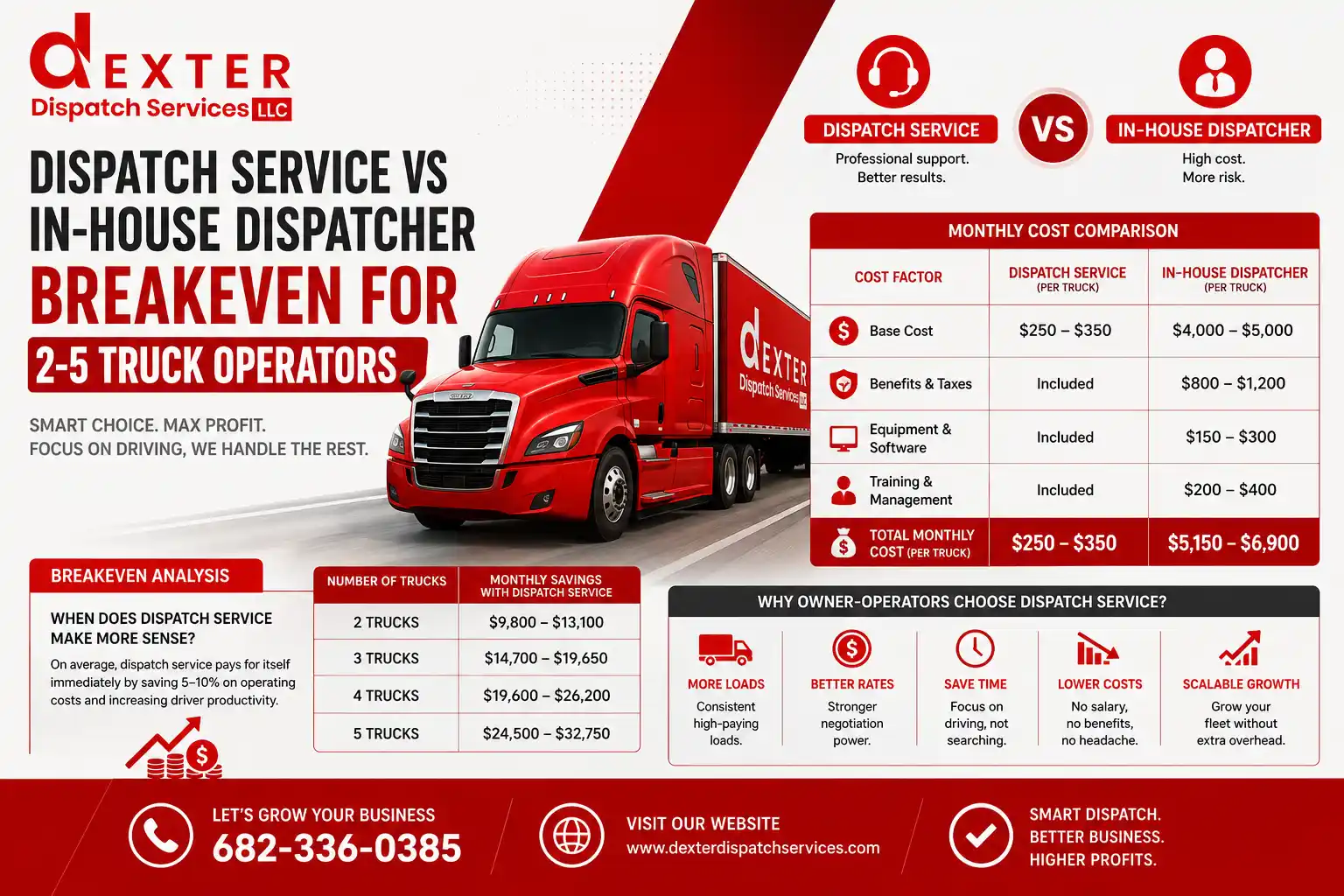
A salary number is not the cost of an in-house dispatcher
Most operators just quote on the basis of $65,000 – $85,000, and that’s it. It doesn’t cost that. Payroll taxes of 7.65 percent. Keep them past month 4, adding health benefits if desired. Place workers’ comp and unemployment insurance, equipment, software seats, and training time. The salary range for a good dispatcher in 2026, fully loaded, is between 90K and 110K per annum.
That’s before turnover. The BLS reported that transportation and warehousing turnover was at 49 percent annualized in 2025. If you need to replace a dispatcher, you are incurring 4-6 weeks of missed reload times on all the trucks they were dispatched on. The line that doesn’t hurt is the one that shows the salary. The zero-seat line is.
What does a service actually cost on a 3-truck operation?
Three $7500 per week trucks. That’s $22,500 a week, $1.08 million a year at 48 working weeks. 7% service is $75,600 per year. At five percent, it’s $54,000. Both numbers are far below a full in-house gross when it is fully loaded.
The higher you go on the rankings, the more you pay. That is the dismal aspect that the operators do not like. It’s also where you’ll find the security in case a truck heads out for two weeks. No revenue, no fee. Whether the wheels turn or not, there’s a salary that comes in.
What does an in-house dispatcher actually do that a service doesn’t?
There are three things when the hire is right. They get to know one shipper’s loading dock tempo inside and out. They’re in contact with one broker on the telephone for the contract you’ve negotiated with them directly. They create their own workflow tailored to your company’s particular equipment combination. That’s none of the “theoretical lift. It’s true if you have to go in-house, and it is untrue if you don’t have to go back to 5 trucks.
The in-house gives me control argument breaks under three trucks
With 3 to 5 trucks, one dispatcher is able to run the trucks well. Thereafter, the lane diversity decreases. They record their knowledge. Brokers, lanes, same reload pattern. This is OK as long as those lanes pay. When market cycles suck up money, and they can’t have 10 other broker relationships to go back to, it’s costly.
Service dispatchers span more than one operator, and they don’t see your freight. Various lanes, various brokers, various reload windows. Lane diversity – there is real lane diversity under the five-truck line. When above, the math turns over. When you reach the percentage fee, it’s like renting ownership.
The breakeven point is fleet size, not gross alone
Run the math. Seven percent service fee on $1,080,000 is $75,600. A fully loaded in-house dispatcher is $95,000 to $110,000. The savings of the service on the cost for 3 trucks are clear. The service will cost $100,800 when it runs four trucks, a gross of $1.44 million. The numbers converge.
Seven percent of five trucks is $126,000. Now you pay more than a salary line, and the Dispatcher you employ is maxed out serving your fleet without being stretched thin. That’s the breakeven. Not gross. Headcount.
The exception applies in both directions. If your operation is four trucks and you have a commitment contract with a shipper, and you are on a set route, you can extremely well justify an in-house operator even sooner, as the Dispatcher’s task is workflow and not the hunt in the marketplace. Even if your book is six truck operations running pure spot freight across mixed lanes, it’s a service, as no single hire will keep that broker’s bench warm.
It is fixed costs at/near the breakeven. If you’re still not sure which hurseys to pick, do some number crunching, compare dispatch service vs in-house with someone who’s worked both of them, by surveying their settlement history for the past three months.
I’ll just hire someone cheap” is the most expensive version of this
A two-year-old dispatcher experience with a $45,000 salary is no bargain. They do not schedule anything that they are not willing to do. They miss detention since they keep undercover of the fact that there are brokers that pay for it without a fight. When a lane dies, they can’t rotate the broker bench. You need to pay the salary, and you still lose money every week.
The rent under the market is also paid off. Six to nine months later, they’re trained, and they know your trucks, and they get offered $70,000. You start over. Do those two cycles in 18 months, and your “savings” cost more than would a senior hire.
The hybrid model most operators don’t consider
Do not have to choose one. We will have a service that takes care of your spot freight and your spot freight Reload Protection. The dedicated contract & shipper relationship is managed by an in-house coordinator. It is based on the gross that the service is booking. Only the contract truck is used for the payroll.
That is the one-time scale that isn’t over three trucks or under seven. You keep flexibility. You maintain a special relationship. No full freight for either model.
Quick decision rule
- 2-4 trucks, typically spot freight – cost and lane diversity are key service wins.
- Four (or five) trucks with one contract (hybrid model). Service for a spot in-house for the contract truck.
- Five plus trucks, own freight, custom workflow requirements: in-house begins to be a cost…with a senior hire.
- Any size with a truck likely to spend 2+ weeks a year: percentage fee.
- When you’re quoting a $50K dispatcher in order to get a lower price, you’re not getting a lower price; you’re not saving money. You’re postponing the very same choice.
Service-vs-in-house, side by side
| Cost line | Service (7% fee) | In-house (fully loaded) |
|---|---|---|
| 3 trucks, $1.08M gross | $75,600 | $95,000-$110,000 |
| 5 trucks, $1.80M gross | $126,000 | $95,000-$110,000 |
| Truck down 2 weeks | Fee drops with revenue | Salary unchanged |
| Lane diversity | Multi-operator broker bench | Limited to hire’s network |
| Custom workflow | Standardized process | Built around your fleet |
| Turnover risk | Absorbed by service | 4-6 weeks disruption per exit |
The number that decides it isn’t on the spreadsheet
It’s the consistency of service that you’re purchasing on both sides. Just wondering, who eats bad weeks? On a service, the fee is based on the gross. A truck is sitting, and the line dips. This means that it’s a fixed cost with an in-house hire, regardless of whether the wheels are turning, or if you are having a “soft month” when business isn’t pouring in, you still have to pay the person you trained and helped develop.
To the left of 5 trucks, the percentage fee is the lower, less restrictive option. Once it overtops five trucks equipped with the right cargo, the money starts to flow into the in-house. That’s the line operators cross on their way up – and the one that’s most commonly violated is the one that runs on top.
Test actual fleets, not the fleet you’ll have in two years. As long as a service remains the more affordable line with the number of people you employ, that’s the answer for now. Review again during the quarter that you sign 5 on the trucks.
Conclusion
Whether to opt for a dispatch service or have an in-house dispatcher mostly depends on the operators’ costs, workload, and growth stage (2-5 trucks). For smaller fleets, in many cases, outsourcing to a truck dispatch service will be the more cost-effective way to run due to the savings of payroll, training, overheads, and many other factors, while still maintaining profitable freight in trucks. As your fleet expands and day-to-day operations become complex, however, an in-house dispatcher can provide a great deal of control, communication, and broker relationships. Most small fleets would still find outsourced dispatch the better option until 5 trucks per month, although this is typically dependent on the monthly revenue, dispatch charges, and special requirements.
👉 Contact Dexter Dispatch Services at www.dexterdispatchservices.com or call us at [682-336-0385]