
There are a variety of different truck driving jobs. The decision of OTR, regional, local, or dedicated trucking impact:
- Income potential
- Home time
- Fatigue levels
- Compliance risk
- Reload timing
- Long-term profitability
It is not a way of life choice only. It’s a decision on the structure of the operations. Get to know what each lane will require before selecting a lane style.
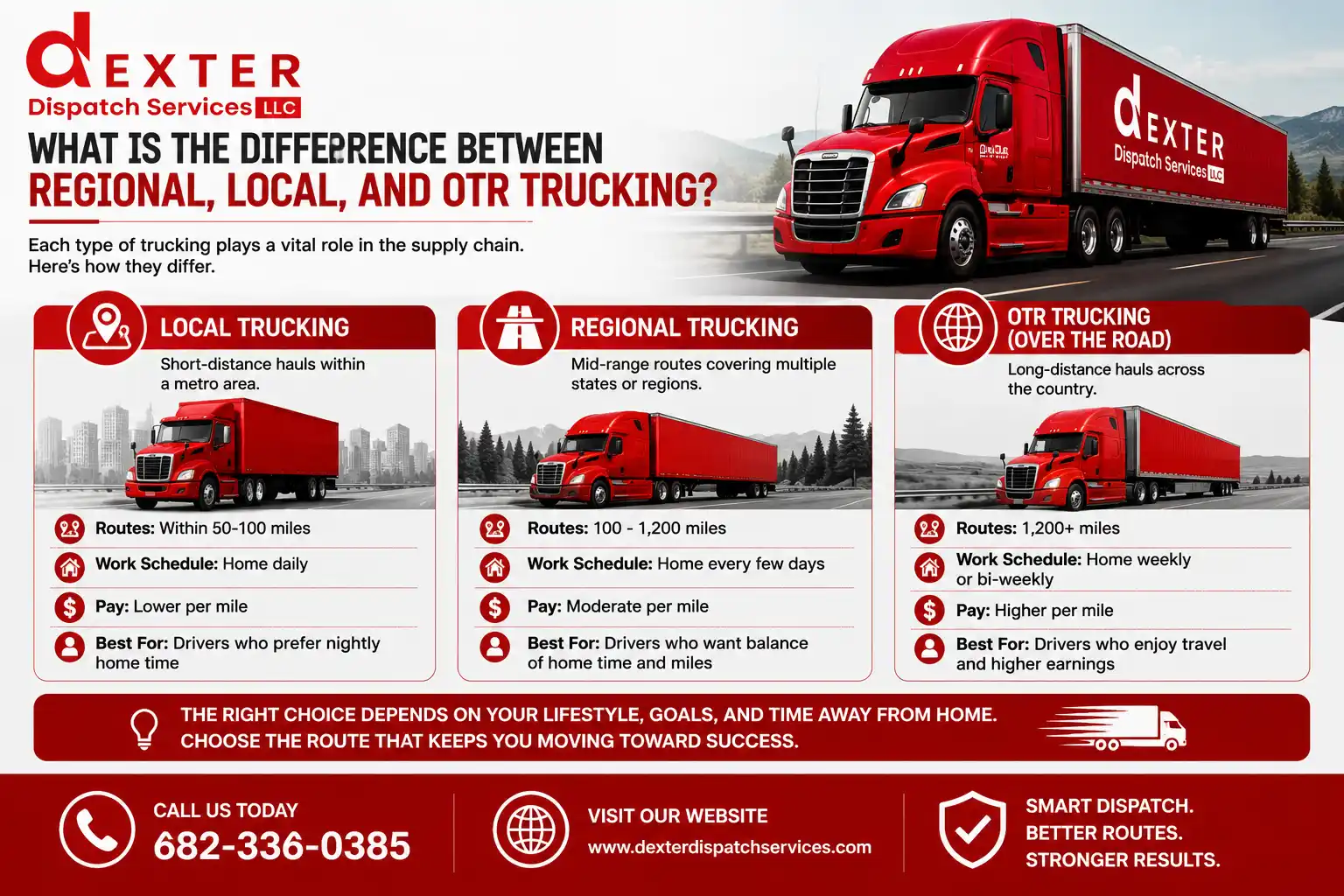
What is OTR in trucking?
What is the meaning of OTR trucks? It’s short for “over the road,” that’s the term used to apply to truck drivers who deliver goods to faraway locations, and are away from home for three to four weeks at a time. OTR truck drivers must be willing to cover the entire United States and Canada. OTR Truck Drivers transport a variety of items such as large freight, machinery, building materials, and other types of equipment.
Over-the-Road (OTR) drivers are responsible for long-haul movements all around the United States and sometimes coast-to-coast.
Typical OTR structure:
- 2-4 weeks in the field
- Interstate or interprovincial transportation of goods.
- Higher weekly mileage
- Longer reset cycles
OTR Drivers transport frequently:
- Dry van freight
- Refrigerated loads
- Flatbed machinery
- Long-distance contract transportation
OTR Advantages
Higher Gross Potential
The more miles = the more money an opportunity is available. Often, experienced drivers who are driving OTR earn more than local drivers.
Freight Diversity
The more access to a wider freight market, the less dependency on one region.
Capacity Stability
There is a safety net against regional slowdowns and national demand.
OTR Challenges
Stronger than usual connections with friends outside of class
It normally takes 2-4 weeks.
Schedule Variability
Freight cycles and HOS pressures may result in very uneven weekly patterns.
Weak miles produce unstable weeks; however, if the OTR loads are bad, then the miles that are strong will be unstable as well. (See: Why Good Loads Still Don’t Mean Good Weeks)
What does regional truck driving mean?
When a truck driver is moving products and resources throughout a local area of the country, it is called “regional trucking.” It is frequently broken into sections like the Northeast, the Midwest, and is usually found within a radius of a thousand miles. The Truck Schedule for over-the-road (OTR) and regional truck drivers is just about the same. The drivers remain on the road for a specified time after which they are allowed to go back home for a set time period, as per the guidelines provided by their employers. One of the biggest reasons to go regional trucking rather than OTR is that the days extended will normally be holidays, which are normally weekdays.
Regional trucking takes place within a multi-state, specified radius—usually 500-1000 miles.
Examples:
- Midwest loop
- Southeast regional freight
- Northeast corridor
Regional drivers usually:
- Return home weekly
- Run predictable corridors
- Maintain regular shipper lanes
Regional Advantages
Weekly Home Time
Compared to a balanced lifestyle, OTR provides a lack of balance in diets that is detrimental to health.
Market Familiarity
Negotiating leverage can come from identifying brokers and shippers.
Reload Efficiency
Know the familiar roads, minimize deadhead risk.
Regional Limitations
This means that the vehicle has fewer miles than OTR.
If the distance is shorter, it can also indicate lower gross — provided that the rate per mile is good.
Market Exposure
When the area slows, freight really squeezes up.
Strong structure – care to be taken in planning the lanes to prevent revenue volatility.
What is local truck driving?
Local trucking means that the driver can be at home with the family every night, which can be a major advantage for those who have a family. Routes are local, with a normal work day of a duration of 8-10 hours and in a radius of less than 200 miles. Due to the nature of the profession, local trucking might be more challenging than over-the-road (OTR) trucking or regional trucking. Many smaller truck driving firms do require 12 or more months of CDL driving experience, as they will require the ability to drive on roads more often than on the highway, and to back into loading docks several times a day. The locals have information about local trucking on this page.
Advantages of Local Driving
- Home Every Night: After a hard day on the road, you will also park your rig and head home each night due to the option to do that. Families and people who can’t or don’t want to be away from their home would do well for local trucking jobs.
- Set Routine: Your routine will nearly always be the same week after week. This will help you maintain a daily routine and work environment. You will be a frequent patron of the businesses you pass on your way, and you will be able to establish friendly relationships with people working in these businesses.
Disadvantages to Local Driving
- Lower Pay: OTR drivers often bring in much more money than local truckers. Although a local truck driver may expect to make $45,000 per year on average, it will take some time before they reach that level of pay.
- Harder to Find a Job: There are fewer opportunities for local truck drivers than over the road. Consequently, you may first require some time to go into a little over-the-road driving before you can even get a local contract.
What is a Dedicated Route?
A dedicated route is when the route of a trucking firm often serves the same company or region. The majority of the time, a truck driver will pick up cargo from a consistent spot and then drive it to a certain customer’s address to drop it off.
Pros of a dedicated route
- Safety: It may be easier to coordinate stops, traffic flow, and overall safety, since drivers tend to be the same and travel on the same loads or routes.
- Consistency: Drivers can build rapport with passengers and strive to keep on track with appointments or schedules.
- Efficiency: Understanding which routes are the fastest and having the ability to complete loads sooner will help improve efficiency and boost mileage revenues.
- Stability – if your carrier’s ability to win loadings is affected by the spot market, what happens? The carrier’s contract with the consumer provides you with security.
Cons of a dedicated route
- Undiversified routes: To travel within a specific region (e.g., the Midwest), there are additional opportunities available for a variety of places and consumers.
- Distance driven: Non-dedicated drivers, on average, drive less distance between a pickup and a delivery than dedicated drivers. The higher the mileage, the lower the “sittage.
There are a number of different types of driver training one must undergo to become a local driver, regional driver, or OTR driver. Truck driving schools will also offer CDL training and specialized OTR training. There are CDL schools that offer financial assistance to help cover tuition fees, and if you’re employed by a trucking company, your company may pay for your training costs. It’s crucial to make sure that the school you’re considering offers hands-on training and to ask whether or not graduates receive assistance when looking for work.
| Category | OTR | Regional | Local |
|---|---|---|---|
| Home Time | 2–4 weeks | Weekly | Daily |
| Weekly Mileage | High | Moderate | Low |
| Gross Potential | High | Medium | Lower |
| Fatigue Risk | Higher | Moderate | Lower |
| Reload Planning | Complex | Structured | Tight schedule |
| Market Exposure | National | Regional | Local economy |
Compliance and HOS Impact
All drivers, regardless of type, are subject to HOURS OF SERVICE (HOS). HOS mismanagement impacts:
- CSA score
- Audit exposure
- Insurance underwriting
If you don’t know the details of how the drive-time limits work for your schedule, check out: How Many Hours Can a Truck Driver Drive?
The authority’s route type is important for the authority holder, as it provides compliance pressure.
OTR + poor sequencing = risk on HOS stacking.
Short-haul log issues are local + tight.
Regional + weather = misuse of the adverse condition.
Compliance exposure is dependent on operational structure.
Which Trucking Type Is Best for Owner-Operators?
The type of “best” depends on:
- Risk tolerance
- Home-time priority
- Equipment type
- Market knowledge
- Dispatch structure
OTR maximizes reach. Regional steadies life and revenues. Local maximizes routine. Dedicated maximizes predictability. However, none will operate unless structured.
Final Takeaway: Route Type Is a Business Model
Opting for OTR, regional, or local isn’t a question of choice.
It’s about:
- Revenue stability
- Load sequencing
- HOS efficiency
- Risk management
- Operational maturity
Drivers who drive the longest are not the ones who make the most money. These are the ones that are more structured through their lanes.
Drive With Structure, Not Guesswork
Dexter dispatch services benefits owner operators in the following way:
- Plan lane strategy
- Sequence loads efficiently
- Protect HOS windows
- Reduce deadhead
- Improve revenue consistency
- Success does not come just from freight type. Structure does.
Talk to Dexter dispatch services to develop a routing strategy in accordance with your objectives.
FAQ
Q1: What is local trucking?
Local trucking involves short-distance deliveries within a city or nearby area. Drivers usually return home every day after completing their routes.
Q2: What is regional trucking?
Regional trucking covers multiple states within a specific region. Drivers may spend a few days on the road but generally return home weekly.
Q3: What is OTR trucking?
OTR (Over-the-Road) trucking involves long-distance transportation across the country. Drivers can stay on the road for several weeks before returning home.
Q4: Which trucking type pays the most?
OTR trucking often offers higher earning potential because drivers travel longer distances and spend more time away from home.
Q5: Which trucking option provides the best work-life balance?
Local trucking usually provides the best work-life balance since drivers return home daily and maintain a more predictable schedule.
Q6: Is regional trucking better than OTR trucking?
It depends on personal preferences. Regional trucking offers more home time, while OTR trucking typically provides higher mileage and earning opportunities.
Q7: Can new CDL drivers start with local trucking?
Yes, some companies hire new CDL drivers for local routes, although many beginners start with regional or OTR positions to gain experience.
Q8: Which trucking type is best for owner-operators?
Owner-operators can succeed in local, regional, or OTR trucking, depending on their business goals, operating costs, and preferred schedule.
Q9: Do regional truck drivers sleep in their trucks?
Yes, regional drivers may occasionally sleep in their trucks when routes require overnight trips.
Q10: How do I choose between local, regional, and OTR trucking?
Consider your income goals, desired home time, lifestyle preferences, and driving experience when choosing the trucking type that best fits your needs.