
Being a trucker without a dispatcher is the best thing to sound like. You decide what to carry, the sequence of carrying and maintain the whole business. There are no service charges, no waiting for a person to find work. And when you get into it, you know it is not but driving anymore. All at the same time, it is its sales, its bargaining, its planning and its getting of paper.
You may be considering taking this path, but you need a picture of what it looks like.
How Drivers Find Loads on Their Own
Load boards are the main beginning for most owner operators. These websites give a list of the freight declared by shippers and brokers. You specify by lane, rating, and equipment, and begin to make calls.
The truth is as follows: load boards are competitive. As soon as a well-paying load is presented, several drivers are already calling on it. Brokers usually prefer drivers with whom they have worked previously. When you are new, you are in general competing with what remains.
It does not imply that load boards are useless. They play a vital role in the initial stages. However, you must be quick, articulate and understand your figures. When you waver or do not sound confident, it is shifted to another person.
Established connections with brokers is yet another avenue. It is here that things begin to get better. Brokers will not forget you as long as you are always on time, communicate effectively, and do not have any troubles of any nature. Eventually, loads are called after you.
Working with direct shippers is the best scenario. That involves having to negotiate with the company holding the freight, and not a middleman. The rates may be reduced and the work more stable. Nevertheless, it is not easy to get there. You must contact, present yourself and demonstrate trustworthiness. The majority of shippers do not risk with unfamiliar carriers.
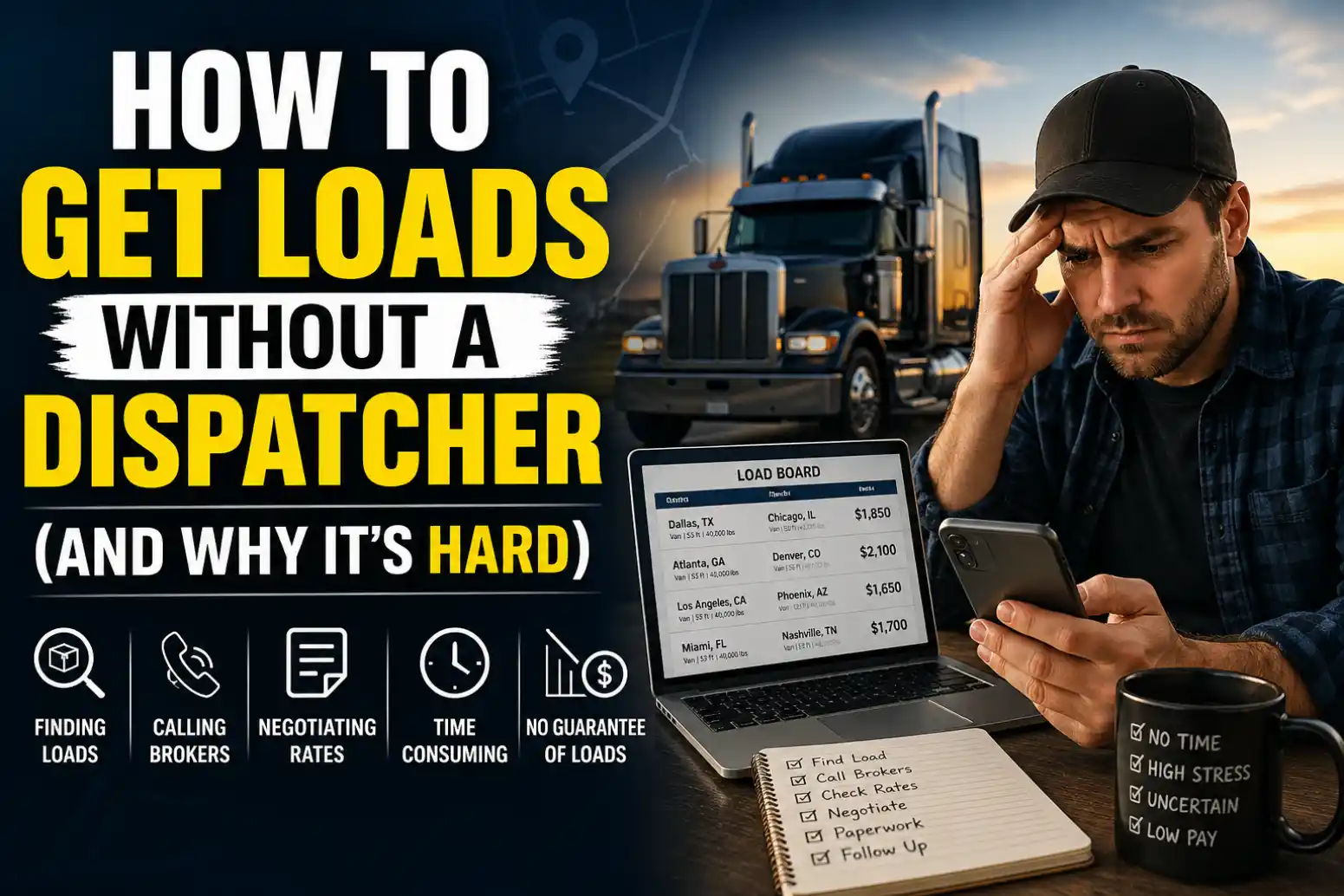
Why It’s Harder Than It Looks
Driving is not the only job. You are dealing with all the stuff in the back office without having a dispatcher.
First, there’s time. Locating loads is cumbersome and time-consuming. You are trolling boards, calling, bargaining and confirming prices. When you are on the road, it is even more difficult. You are attempting to make safer trips and communicate business at the same time.
Second, there’s negotiation. Brokers are educated to achieve an optimal deal on their part. When you are not aware of what is going on in the market, you can easily take on a load that barely meets whatever costs you have. All the expenses, such as fuel, maintenance, insurance, and deadhead miles, mount up fast. A single bad rate will cost you the day.
Third, there’s inconsistency. And with no stable network, your income will be up and down every week. There are weeks when you are booked up. Other weeks, you will go and refresh load boards in a bid to identify something that makes sense.
Another significant portion is paperwork. Rate confirmations, invoices, broker packets, compliance documents- it all must be in order. Failure to get something results in delaying payment. And in trucking, cash flow is important.
The Hidden Challenges Most Drivers Don’t Expect
Among the largest problems is the deadhead miles – driving without cargo. You will be finding yourself wasting fuel and time only to pick the next pickup. Planning of routes is normally done in order to minimize this by dispatchers. The moment you are left alone, you are forced to think ahead all the time.
Decision fatigue is another challenge. You are making business decisions every day. What to carry, what to run in, or with a rate better than that. It gets you worn out with time. No longer is it about physical driving; it is mental pressure.
Next is the decrease in leverage. Networks and volume are common features of dispatchers. They provide work with several drivers and brokers, which provides them with more access to loads. You are not a single driver and, therefore, you do not enjoy that advantage at first.
What Actually Helps You Succeed
In case you are serious about running without a dispatcher, you should have a system.
The first step is to get to know your numbers. Determine the cost per mile, fuel, maintenance and insurance, fixed cost. This provides you with a point of reference. Do not take a loading that is below your break-even level.
Then, concentrate on communication. Be to the point when calling a broker. Confirm details quickly. Brokers like car drivers, who are easy to handle. It will raise your chances of receiving a repeat call.
Build relationships intentionally. Although a load may not be flawless, providing it in a smooth manner may result in better prospects in the future. Contact mutually worked on brokers. Keep on top of them.
Plan your lanes. You can avoid just travelling after any random loads; instead, you can attempt to travel in the areas where the demand is steady. This saves you time lost and increases your chances of getting a good remuneration freight.
Finally, stay organized. Have your documents in hand. Issue invoice promptly. Track your payments. Any little bit of paperwork errors can slow down your cash flow and cause undue anxiety.
Is It Worth It?
It varies according to your circumstances.
Running without a dispatcher may be effective, provided that you have control issues and you do not mind doing the business part of it. You retain complete control of your business and the capability of establishing direct relationships that are profitable in the long run.
However, when you are focused on driving and you want to spend the maximum time on the road, then the workload may be overwhelming. Most drivers begin to work on their own and then change their mind and use a dispatcher, seeing how time and energy-consuming it becomes.
No right, no wrong option. It has to do with knowing the trade-off. It is either the money or your time and effort.
Conclusion
It is possible to get loads without a dispatcher, although it is not as simple as it may be. You’re no longer a driver; you are in business. It implies the seeking of freight, the negotiation of rates, the administration of paperwork, and the investigation of planning every day in, day out.
When you enter into one with the right attitude and systems, then you can make it work. However, most drivers have a problem disregarding the difficulties. The more you are realistic about the process, the more likely that it will keep you profitable and consistent.
👉 Contact Dexter Dispatch Services at www.dexterdispatchservices.com or call us at [682-336-0385]