

Whether you’re a company-hired driver, carrier, or owner-operator, you are required to follow the trucking industry regulations established by the federal and state authorities. With the help of these standards, the safety on the road is ensured, thus preventing the risk of accidents. The Compliance, Safety, Accountability (CSA) program is one of the components of the US trucking regulations web. The CSA programme addressed and improved the road safety. It helps to track the violations and gives points for non-compliance, which helps to see the safety record of drivers and carriers. Understanding how the CSA program works, points calculation, and their impact is part of every trucking sector worker’s job.
What is the CSA Program?
The Compliance, Safety, Accountability (CSA) is the safety compliance program established by the Federal Motor Carrier Safety Administration (FMCSA). When drivers do not comply with the DOT regulations, they are given CSA violation points. They show the severity of a violation in on a scale from 1 (least severe) to 10 (most severe). The points are calculated by using the CSA points chart. For example, major problems concerning truck maintenance or unsafe driving behaviour can result in increased CSA violation points.
The number of these points is monitored for a period of time. A high number can result in higher scrutiny from FMCSA, in the worst case, fines and suspension of operation. Therefore, awareness about the DOT violations list and solving any potential issues is important to have a good safety record.
It is important to understand the CSA program for anyone that works in the trucking industry. This has direct impact on the operational status and reputation pf your businesses. You can be sure of continued compliance with federal safety regulations by proactively managing your business and addressing problems that can result in violations,
How are CSA Points Calculated?
CSA points are calculated depending on the severity and frequency of violations of FMCSA safety regulations. When a driver does not follow the DOT standards, then a violation is recorded along with the associated quantity of CSA violation points. This dictates the safety rating of a driver, thereby influencing the operational status and reputation of the industry. The FMCSA monitors the safety performance of the drivers through these points.
The process begins with The CSA points chart. It’s an extensive tool that classifies infringements according to their severity. Violations are rated according to a scale. The less compliance cases receive fewer points, and the more serious violations are subject to higher points. An example would be an error on paperwork that would result in fewer points, and a vehicle brake failure or speeding above the limit would attract higher CSA points for violations.
In addition, CSA anticipates time-weighted marking of violations. This means that older violations are of less significance than recent violations. This is to encourage the continuing adherence to safety rules.
The FMCSA points for violations will also mount up quickly in the event of multiple violations. A high number of points could result in more frequent inspections, the costly acquisition of insurance, and more harsh penalties for violations.
For good CSA points managing, you should regularly check your compliance state and address the point if you have any issue to prevent violation. This includes being aware and up-to-date about the list of DOT violations, proper maintenance of vehicles, and safe driving practices.
Types of Violations and Their Point Values
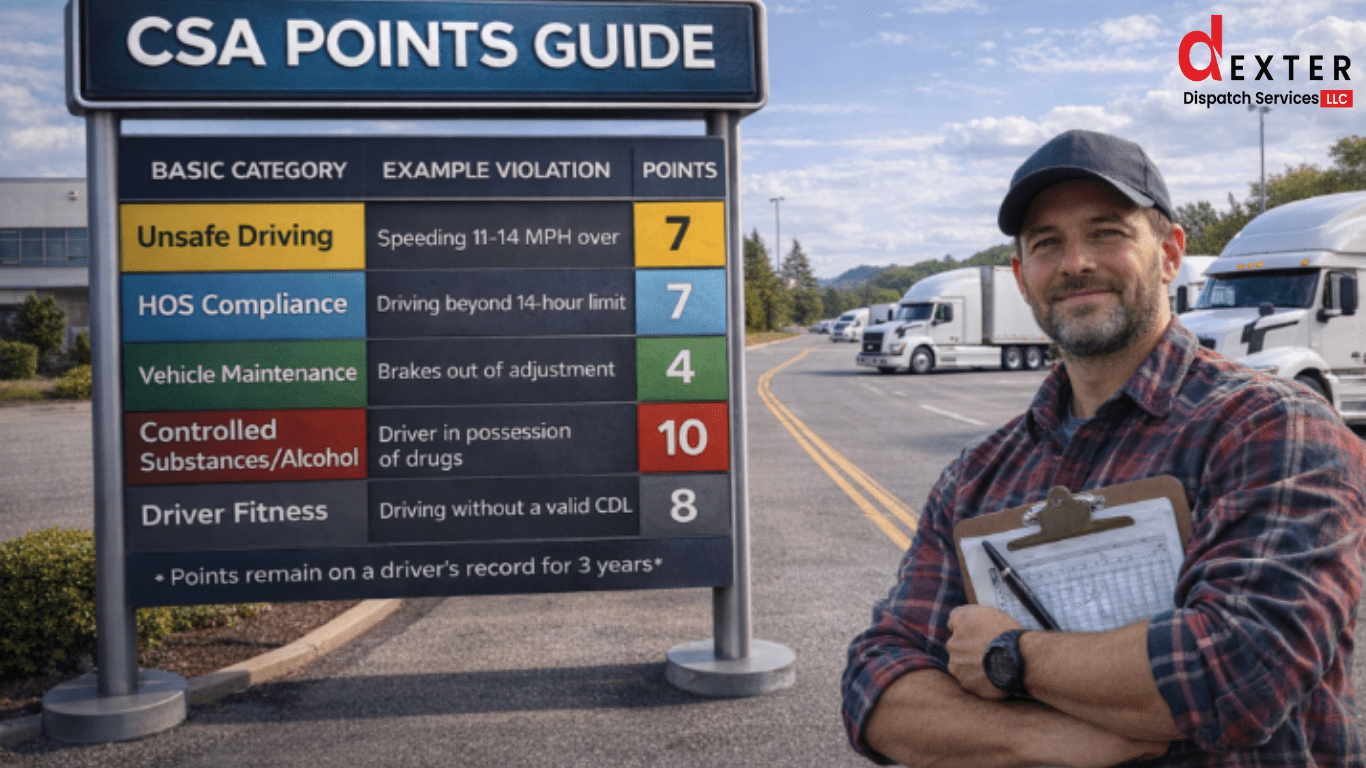
The CSA program contains 7 Behavior Analysis and Safety Improvement Categories (BASICs). Each of the categories shows different aspects of the trucking operations. The severity of these violations is based on the potential risk of these violations to safety. Knowing these categories and their corresponding point values is common sense to keep drivers in compliance.
Unsafe driving. This category includes dangerous driving behaviour such as reckless driving, speeding, disobeying traffic signals or improper lane changes. This is one of the most important categories, as this represents the immediate risk. For example, speeding or reckless driving can earn up to 10 CSA violation points. This is a serious violation because the adverse consequences of such violations can cause accidents.
Hours of Service (HOS) Compliance. HOS regulations are expected to be able to prevent driver fatigue, a major component in road accidents. This category includes breaking violations of any driving more than allowable hours, incorrect records, and false records of activities. The CSA points for standards violations from HOS are different based on the nature of the infraction. In particular, minor errors in paperwork can mean 1-2 points, and exceeding the maximum driving hours, 7 or more points.
Driver fitness. This means the qualification and health of a driver. The FMCSA has specific requirements that drivers must have the proper documentation, such as having a valid commercial driver’s license (CDL) and medical certifications. Violations for this category can be found in driving without a CDL, an expired medical certificate or lacking the documentation necessary to do so. Driving without having a valid CDL could be charged with a high point value because of the importance of this document.
Controllers for substances and alcohol. This type covers those violations involving the use or possession of drugs or alcohol by the driver while operating a commercial vehicle. The category has the most CSA points for violations with the extreme danger of impaired driving. A driver who drives under the influence of alcohol or drug could get up to 10 points. Even less severe violations, even possession on duty can result in significant points.
Vehicle maintenance. These violations are focused on the condition of the vehicle and a driver’s adherence to maintenance standards. This includes such issues as brake system failures, defective tyres, and imperative lights. Minimising these violations can be done by regular inspections and timely maintenance. Good The point of such non-compliance is the CSA points, which vary against the severity and the potential safety impact. For example, 7-10 points can come as a violation of the brake system.
Hazardous materials are a compliance. Drivers shipping hazardous materials are required to follow stringent regulations in order to avoid accidents and maintain safety. The category covers violations of improper labelling or packaging or handling of hazardous materials. Transporting hazmat without proper labelling and placarding can result in high points in the midst of the risk.
Crash indicator. The category measures how many times a driver has been involved in crashes (whether at fault or not). Then, this history is used to calculate a risk profile influencing a safety rating. Though the crashes themselves do not factor into specific point averages, the crashes do affect the CSA score. Frequent or severe crashes may show an increased level of scrutiny by the FMCSA, and new safe driving practices and prevention of accidents would need to be implemented.
How Many CSA Points Can a Driver Accumulate?
In ** But there’s no preset number on how many CSA points a driver can have. Each violation has a certain weight and adds a value of points to a driver’s record. They stay on the records of both a driver and a carrier for several years. That gives an opportunity to FMCSA to check the incoming compliance of safety rules and to avoid the possibility of road accidents.
There’s no limit to the number of CSA points, but getting too many CSA points can lead to serious penalties. In particular, it can bring about increased insurance sates, fines, damage to reputation as well as disqualification from certain jobs. Carriers can lose their ability to operate because their drivers frequently get high CSA scores.
How Long Do CSA Points Stay with You?
CSA’s points remain with a driver’s safety record for two years, and a carrier’s safety record for three years. The length of time is calculated from the date of the violation. During this period, the points affect the overall score on the safety department, which is monitored by FMCSA, for ensuring compliance.
СSA points are time-weighted. Therefore, recent violations are given the most weight. In particular, for the first 6 months, the points have all of their weight and are worth the most to the safety score. The recent violations are considered to be more reflective of current practices of a driver/carrier to ensure safety.
After the 6-month period, the points begin to lose weight. Normally, they have around 66% of the original value.
During the period from 12 to 24 months, the impact continues to diminish. During that time, the points weigh around 33% of the initial value.
In the last year of the CSA points, their weight impact is minimal. The points weigh around 20% until fell off after 36 months.
Understanding Out-of-Service Violations
Out-of-Service (OOS) violations- the most serious type of non-compliance violation with significant consequences to drivers and carriers. When a vehicle or a driver is put out of service, it means that to continue the operation would be a significant danger to safety. These violations are caught during roadside compliance check-ups, reviews, enforcement.
Knowing the various types of OOS violations and the circumstances that lead to such violations is crucial in order to ensure continued compliance and smooth operations. Generally, two types of OOS violations are covered in those laws:
- Driver relates out-of-service violations. This type covers cases when a driver is found unfit for a commercial motor vehicle opening. These violations have multiple reasons, such as invalid or missing CDL, hours of service violations, drug or alcohol use or possess during driving, medical disqualifications or expired certificates.
- Out of service violations related to vehicles They occur when reckoned the condition of the vehicle is unsafe to operate. These violations typically pertain to the physical condition of the vehicle, such as brake system failures, tire defects, lighting and signaling problems, improper load securement and steering or suspension problems.
OSS violations are critical violations of safety standards that can have far reaching consequences. Carriers and drivers should be focused on regular maintenance, compliance with regulations, and careful inspections in order to minimize the chance for being out of service and for having a strong safety record for their operations.
These violations have major effects on CSA points and safety scores of carriers and drivers. As OOS violations are critical to safety, these violations are worth more points. For example, a violation of the OOS, such as brake failure may be worth up to 10 CSA points.
State-Specific CSA Points and Regulations
While the CSA Program is regulated by federal standards developed by the FMCSA, states also play a significant role in enforcing the safety regulations. Each state has its set of rules and procedures in place in reporting, assigning, and handling CSA points. You should know the rules and CSA points handling of the state in which you work. This helps you stay on the right side of the law and have operations flowing without interruptions.
Some states may have certain laws to follow when it comes to safe traffic compliance. While the FMCSA provided the minimum level of safety, States can add further requirements that drivers and carriers must adhere to. Violations of the state-specific rules may still contribute to CSA points if they cover the categories of FMCSA violations.
The level of enforcement may also differ from state to state. In particular, certain states may also have more severe enforcement of certain violations or more frequent roadside inspections. For this reason, it is possible to have higher chances to receive CSA points in states that have a stricter enforcement practice.
In addition to this, states can impose their own penalties, such as fines, license suspensions, or other actions.
Examples of State-Specific Regulations
Here are a few examples of state-specific regulations and how they affect CSA points and overall compliance.
- California. The state is known to have very strict environmental regulations. California has additional requirements for emissions and vehicle maintenance. Non-compliance related to environmental standards in California can receive CSA points and state fines.
- Texas. There is a large network of roads and an important trucking industry in the state. This includes rigorous inspection at roadside. Texas also has the reputation for being very particular about vehicle maintenance and safety standards. Thus, drivers are more likely to be inspected and given violations here.
- New York. The state has some strict regulations regarding the shipping of hazardous materials. Violations can lead to CSA points and state-imposed penalties.
How to Check and Manage CSA Points
Effective management of CSA points ensures a strong safety record and verrifies adherence to the FMCSA regulations. Drivers and arriers should regularly check their CSA score and address any violations to avoid penalties.
How to Check Your CSA Points
- Accessing the FMCSA portal. The first step in the check of your CSA points will be to access the FMCSA’s Safety Measurement System (SMS) portal. It gives you detailed information of your CSA score. For the access, you need your DOT number, as well as a personal identification number.
- Reviewing Safety Measurement System (SMS). On the SMS portal, you’ll be able to: – You’re your overall CSA score with a breakdown of the number of points in each of the seven CSA categories.
- Understanding the points broken down. The SMS portal to see the specific violations. The list contains each violation and its respective CSA points as well as the date it was captured and the time-weighted impact.
- Monitoring for changes. FMCSA updates the SMS data on a monthly basis. That is why it is important to check your CSA points to be aware of any changes.
Managing CSA Points
- Handling violations as soon as possible. If a carrier or a driver is issued a violation, he or she should correct the violation immediately. This can include vehicle maintenance, providing other training to drivers or updating your safety practices. Prompt action can avoid further CSA violations and minimise the potential for building up valuable CSA points.
- Disputing false violations. If you assume that the violation was given in error, you can contest it via the FMCSA’s DataQs system. You should bring documentation and proof to support your claim. Successfully disputing of violation may lead to removal or reduction of CSA points.
- Implementing preventative measures. Drivers and carriers should use regular vehicle inspections and maintenance, be aware of HOS regulations, and pay attention to new changes to federal and state regulations regarding.
- Compliance audits. You also an conduct regular audits against compliance so that you are able to identify potential weak points in your safety practices. The audits should include a review of vehicle maintenance records, driver logs, and other required documentation.
Tools and Resources
The use of tight tools and resources is very essential for managing CSA points and maintaining their compliance with FMCSA safety regulations. With them, you will be able to overcome any hazards with the risk of any violation occurring, enhance your safety record, and ensure the continuity of your operations.
- FMCSA SMS Portal. It’s said to be the primary instrument of monitoring your CSA score. The portal tells you about your violations and points they have against the CSA as well as their effect on your safety record. This includes your violation history, performance tracking, and how you compare with other carriers as far as safety goes.
- FMCSA DataQs System. This is the key tool in countering erroneous violations. The system lets the submission of a request for data review and supporting documentation.
- (Technology Used in Transport Safety) Electronic Logging Devices (ELDs). They are very important in assurance of compliance with HOS regulations. The devices automatically record the number of driving hours to help drivers stay within allowed hours driving and working.
- Software for vehicle maintenance. Periodically checking missions of their vehicles and maintaining them is key to the prevention of violation. Vehicle maintenance software—This software will help carriers to manage and track the maintenance schedules for all the fleet vehicles so that they meet the compliance for all vehicles.
- Safety management software. These solutions help carriers and drivers monitor and manage everything regarding their safety performance. Usually, included in these platforms are CSA score tracking, driver’s performance monitoring, and incident reporting.
- State-specific resources. You can stay up-to-date on state safety requirements from state Department of Transportation (DOT) websites, which contain information on specific laws and upcoming changes to laws and state inspection programs to assist in ensuring safety standards.
- FMCSA and DOT publications. The information sources we recommend are the FMCSA and DOT because they frequently publish information regarding guidance, updates, and regulations that affect CSA points. You can continue to be informed by the FMCSA Safety Advisory Notices or new regulations for DOT.
Conclusion
The CSA program is a major part of how the trucking industry evaluates safety performance as a whole. Understanding the calculation of CSA points, the duration of those points, and some of the consequences to drivers and carriers of those points helps in order to stay compliant and maintain long-term operations authority.
By keeping track of their safety records on a periodic basis, making sure their violations are addressed on time, and being abreast of federal and state regulations, drivers and carriers can minimize enforcement risk, avoid costly penalties, and retain a strong safety profile in an increasingly regulated environment.ax
👉 Contact Dexter Dispatch Services at www.dexterdispatchservices.com or call us at [682-336-0385]