

The Hidden Math of “Saving Money”
This week, you saved $300 on dispatch fees, which seems like a smart way for an owner-operator to save money. But what if that “savings” cost you $1,200 in lost income because you spent 15 hours looking for loads instead of driving?
That’s not how most owner-operators see it. People often consider dispatch to be an extra cost that they can handle themselves as long as load boards are open, phones work, and they have some experience. And to be fair, many drivers can find loads on their own. That’s not the problem.
In our most recent article, “How to Vet Freight Partners: Red Flags Every Owner-Operator Should Know,” we talked about how to spot shady brokers and stay away from obvious scams when you do the vetting yourself. And today we’re answering a more difficult question: why spending 10 to 15 hours a week finding, vetting, and negotiating loads yourself could be one of the biggest hidden costs of your business.
When you really think about it, you’re not just finding loads. You’re doing sales, negotiating, assessing risk, doing paperwork, and following up. Your truck isn’t moving or making money while you’re doing those things.
You became an owner-operator so you could drive, not so you could sit around refreshing load boards, chasing brokers, or second-guessing rate confirmations. But that’s exactly where a lot of otherwise profitable businesses waste time, energy, and money.
This article explains the real costs of using a dispatch service for owner-operators, not the sales pitch, but the numbers. We’ll explain why trying to “save” on dispatch often costs more than it saves, and why experienced drivers stop looking for their loads not to work less, but to make more money more consistently.

The Real Cost of DIY Load Finding
Let’s do a realistic time audit, not one that shows the best or worst case. Just okay.
Finding one load isn’t a five-minute job for most owner-operators who do spot freight. It usually takes two to three hours to lock in a load because you have to scan load boards, check out brokers, negotiate rates, and make sure everything is correct. If you do that three to four times a week, you’ll lose nine to twelve hours before the truck even moves.
And that’s just the part of the work that you can see.
The “invisible” tasks start to pile up once the load is booked. You need to look over and sign the rate confirmations. People ask for insurance papers. Brokers either follow up or don’t, which means you have to chase them. Payments are late, arguments last longer, and factoring companies need to be kept up to date. Your phone keeps buzzing with emails, texts, and “just checking in” calls that interrupt your day and your focus.
That time audit goes beyond the first estimate very quickly. What began as nine or ten hours quickly turns into fifteen or more hours every week.
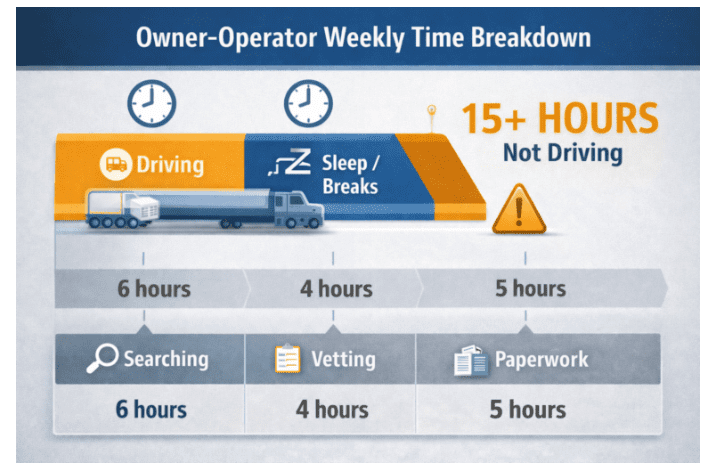
That’s fifteen hours you’re not driving.
Fifteen hours your truck is sitting.
Fifteen hours you never planned for when you bought the truck and decided to run your own operation.
The Opportunity Cost Formula Most Drivers Ignore
This is where the math makes a big difference. Truck drivers don’t often think about this opportunity cost, but once you see how much it costs to search for loads yourself, the choice becomes clear.
Use a cautious, real-world example. Let’s say your truck makes $4,000 a week. You work about 70 hours a week, between driving and doing office work. Your real hourly rate isn’t your CPM when you divide your income by the amount of time you actually worked. It’s more like $57 an hour.
Look at those fifteen hours again. They were spent looking for and checking loads instead of driving.
There is a $57 opportunity cost for each of those hours. That comes to about $855 over the course of a week. This is not due to a mistake on your part, but rather because you could have utilized that time more effectively to generate revenue. This phenomenon is also why using load boards all the time may seem like a good idea at first, but it doesn’t work out in the long run. In our comparison of load boards and dispatch, we go into great detail about that trade-off, including how DIY sourcing slowly eats away at both time and profits.
And that’s not even counting the secondary effects that most drivers notice right away: missing better-paying lanes because you didn’t have time to look for them, deadhead miles because you were in a hurry to load, loads that were turned down because you were too tired to properly evaluate them, and decisions made at the end of long days when your judgment is already worn thin.
The Mental Load Nobody Prices In
There is also a cost that no spreadsheet shows.
The work never really stops when you do everything yourself. You always feel a little anxious about your phone, like you can’t fully disconnect even when you’re at home. At the end of a long day of driving, you may feel like one more call or rate decision is too much. And there is the constant worry about whether a broker will pay on time or at all.
This stress is why so many drivers think they are busy but aren’t getting anything done. The days and weeks are full, but the results don’t always show how hard you worked. They work in the business all the time, reacting to tasks as they come up, but they don’t often work on it in a way that gives them an advantage.
And this is where the question starts to change.
It’s not just “How do I save money?” anymore.
It turns into: how to make money as a truck driver by saving time instead of getting stressed out?
Case Study – The $1,200 Shift
From Broker Dialer to Highway Driver
This situation will seem familiar.
You drive one truck. You know how to find loads, talk about prices, and handle paperwork. You like being independent and don’t like having to deal with middlemen.
You dedicate approximately 15 hours each week to the task of locating and inspecting loads prior to their dispatch. You get three loads a week, each worth about $1,200, for a total of $3,600 a week. You don’t have to pay any dispatch fees, and you make all the decisions.
That looks appealing on paper.
In real life, the week hardly ever goes smoothly. Mondays start off slowly while you look. Fridays feel like they go by too fast. The truck sits longer than it should, and you often have to choose between an “okay” load right now or waiting and hoping for something better to come along.
When dispatch comes into play, the week takes on a new shape.
You don’t have to spend hours looking for and negotiating loads. Instead, you only have to spend about two hours a week reviewing and approving them. The dispatcher is responsible for finding, checking, and negotiating. With better sequencing, you can get four loads a week at the same price of $1,200 per load, which brings your weekly gross to $4,800.
The numbers speak for themselves. Every week, income goes up by $1,200. After paying a typical $300 dispatch fee, the net gain is $900, and 13 hours are saved.
There was nothing magical that happened. No hidden lanes. No new tools were introduced. The goal is to utilize time more efficiently.
The practical answer to the question of whether a truck dispatcher is worth it is no, not emotionally, but economically.
After a few weeks, most drivers tell us the same thing: “I didn’t know how much time I was spending just trying not to make a bad choice.”
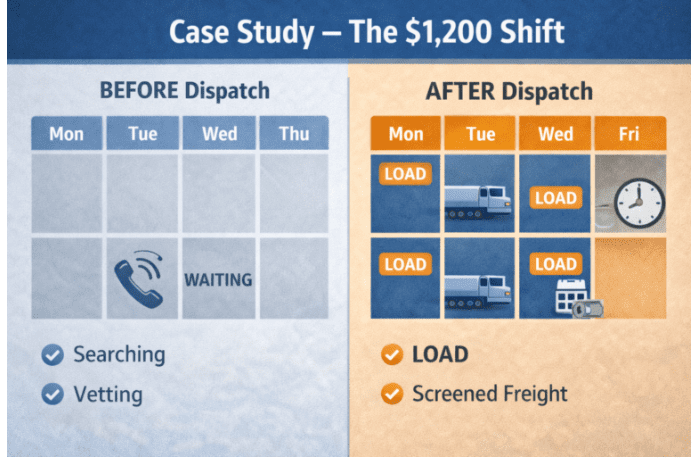
If this math looks familiar, it’s because most owner-operators already feel it – they just haven’t put numbers to it.
What You’re Actually Buying with a Dispatch Service
Beyond Load Boards: The 4 Things Dispatchers Actually Do
Many drivers think that dispatch means someone else is looking at the same load boards. A real dispatch service for owner-operators doesn’t do that.
It’s not about convenience; it’s about leverage. A professional freight dispatcher does more than just look for load boards. They also give you access to the market, check out brokers, and negotiate rates that most independent drivers can’t do on their own.
Dispatch works with brokers it has worked with before, on lanes it has worked on before, and with pricing information that has built up over time. You talk about things as one truck. As a network, dispatch negotiates.
Vetting is not based on hope; it is based on facts. To lower the risk of not getting paid, last-minute cancellations, and rate changes after pickup, Carrier411 reports, TIA watchlists, and payment history databases are checked.
Repetition makes negotiation better. Dispatchers know which lanes are paying this week, when to push, and when to walk away. They negotiate new things, not between drives.
Paperwork doesn’t go away either. They take care of everything from confirming rates to talking to the broker to following up on payments to dealing with disputes.
That alone tells you how to save time as a truck driver better than any productivity hack ever could.
The Financial Breakdown (DIY vs. Dispatch)
The Calculator That Changed Our Clients’ Minds
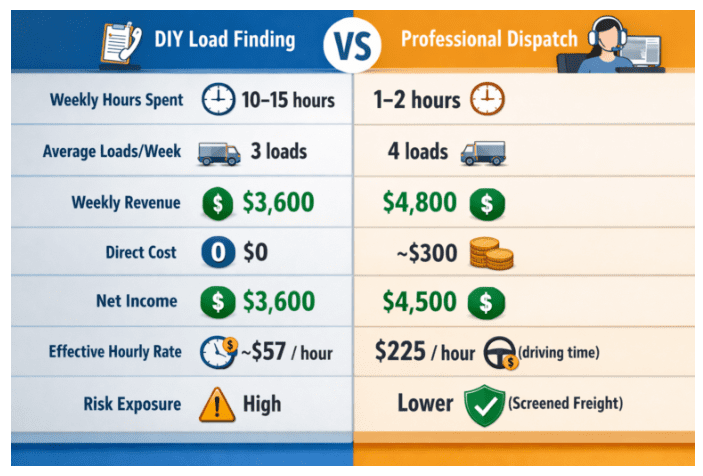
This isn’t theoretical.
This is why operators who ask “Should I stop finding my own loads?” often answer their own question once they see the math.
The 3 Biggest Fears About Dispatch Services (And Why They’re Myths)
What’s Really Holding You Back
The first fear is losing control. In reality, dispatch gives you more strategic control by getting rid of execution noise.
The second worry is that the incentives won’t be aligned. But bad loads make people stop using them. One bad load can destroy weeks of trust. Long-term relationships are more important than quick cash.
The third fear is the price. If dispatch can find one extra load a month that pays for the fee, all the rest is profit. Most operators see a return on investment (ROI) in the first week.
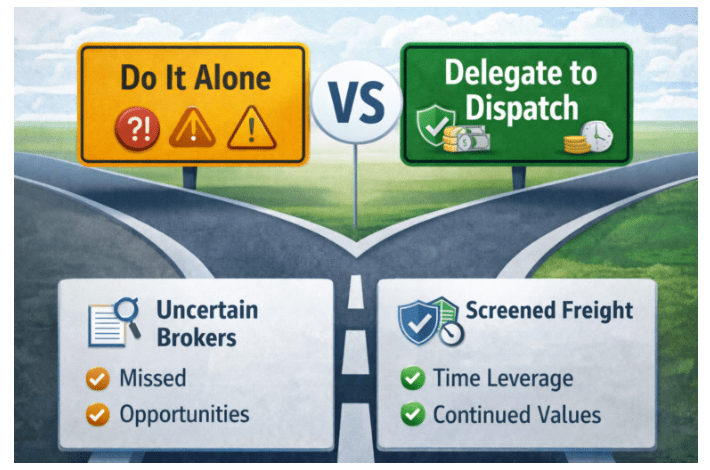
That’s why the real question isn’t whether or not a truck dispatcher is worth it; it’s how long you can keep paying for everything yourself.
How to Test the Waters Without Risk
Your First Step: The 1-Load Experiment
You don’t have to commit without thinking.
Follow a normal week. Keep track of the hours worked, the loads booked, and the money made. Then try dispatching with one load in a lane you know well. Look at the rate and the amount of time spent.
It doesn’t take long to see the difference.
Give us one load to try. If we don’t provide a better deal than what you could have found on your own after paying us, the next week will be free.
👉 Contact Dexter Dispatch Services at www.dexterdispatchservices.com or call us at [682-336-0385]