

In 2026, the trucking market will reward getting things done, not growing.
There is a steady but limited demand for freight, which means there isn’t much room for mistakes in operations.
Rates are going up, but not in a steady way, and they are still well below their peak levels when adjusted for inflation.
Owner-operators who set lanes, rates, and costs will do better than those who just want to get more business.
We help owner-operators deal with tight margins, uneven demand, and rising fixed costs every day at Dexter Dispatch Services. The market itself is not what makes some operators successful and others fail. The decisions made between loads, not the truck’s level of busyness, determine success.
The trucking market isn’t falling apart as we move into 2026, but it isn’t being nice anymore. Freight is moving, but capacity is slowly getting tighter, and prices are only strong in certain lanes. In this situation, waiting for a broad recovery won’t help you succeed. It comes from working with care.
This guide is for owner-operators who want to succeed in today’s market, not the one many hope will return.
Stop Waiting for a “Good Market”
Many owner-operators still think that the freight cycle will eventually resolve all problems. The idea is that if they can hold out long enough, things will get back to the way they were before, when almost any load made sense.
That idea is no longer true.
Freight demand going into 2026 is not growing fast enough to cover up mistakes in operations like it did in previous recovery cycles. Inventory levels in stores are mostly back to what they were before the pandemic. The ratio of inventory to sales is now close to what it was in 2018–2019, after peaking sharply in 2022. Manufacturing output is still inconsistent, with growth rates that range from flat to low single digits instead of steady growth. Import volumes are still 20–30% lower than the 2021 surge, but higher than post- pandemic. This limits the potential for port-driven truckload freight.
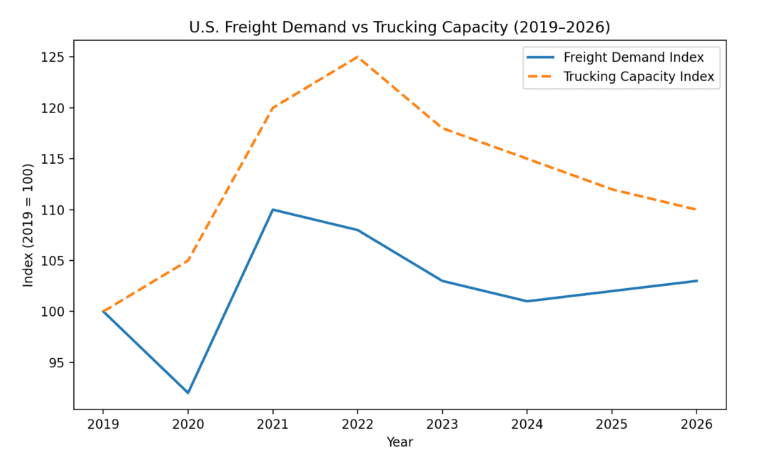
Because of this, there is freight available, but not enough to raise rates across the board.
People who wait for a big change in the market often lose money in the meantime. People who adapt their business operations to fit the current situation stay in business long enough to benefit when the cycle turns.
Why Dispatch Strategy Is the Deciding Factor in 2026
In less strict markets, volume often masks poor dispatch decisions. Profit is rapidly eaten away by the same decisions in more competitive markets.
In 2026, dispatch is no longer about keeping the truck moving at all costs. It’s about keeping the business safe. Every load choice changes the deadhead, the timing of maintenance cycles, cash flow, and the ability to negotiate on the next run.
Owner-operators who see dispatch as a strategic function instead of a reactive task make fewer decisions, but they are better ones. They know when it’s cheaper to wait than to move, when a lane is working, and when a rate is quietly paying for someone else’s freight.
That difference gets bigger over time.
Lane Discipline Beats Rate Chasing
One of the most common mistakes people make in the current market is to move from one area to another for slightly better rates. This method can work for a short time, but it usually means longer empty miles, fewer reload options, and earnings that aren’t always predictable.
Lane discipline makes things stable. Operators who stay within familiar corridors know the real cost per mile, where freight always reloads, and how to negotiate based on experience instead of hope. Over time, such discipline cuts down on deadhead, makes planning more accurate, and makes cash flow smoother.
In 2026, making money isn’t so much about finding the load that pays the most as it is about running lanes that always work.
Rate Control Is a Skill, Not a Market Gift
Not everyone gets better rates at the same time. First, they get better for operators who know their numbers and stick to them all the time.
Even though the spot market got better in late 2025, truckload prices are still much lower than they were at their highest point in the last cycle when adjusted for inflation. During the 2021–2022 surge, many dry van spot lanes briefly went over $3.00 per mile on a nominal basis.
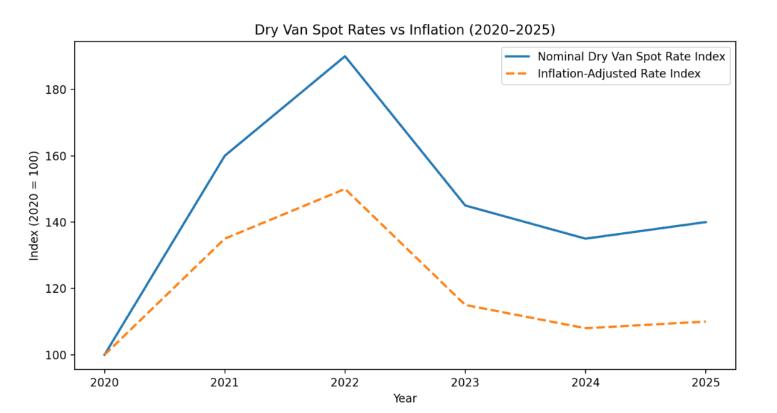
Prices today would need to be significantly higher to equal that purchasing power if inflation were taken into consideration. Many lanes, on the other hand, are still doing business at levels that leave single-truck operators close to breaking even after taking into account insurance, maintenance, and financing costs.
This is why rate discipline, not rate optimism, is what makes a business profitable right now.
Owner-operators who take weak freight “just to keep moving” often put themselves in bad positions when it comes to negotiating. When capacity becomes tight, those who set realistic rate floors are the first to benefit.
Cost Control Begins Before the Truck Moves
Although fuel prices change, it is no longer the main factor endangering profitability. Insurance, financing, maintenance, and compliance are the most risky expenses in 2026.
Non-fuel expenses now account for the majority of operating expenses for many owner-operators. For many small carriers, insurance premiums alone have doubled or more from pre-pandemic levels, and equipment financing is still costly. Small inefficiencies in dispatch choices can result in annual margin losses of thousands of dollars in this setting.
Poor load sequencing results in unnecessary miles. Inconsistent lanes increase wear and tear. Reactive scheduling results in expensive malfunctions and postponed maintenance. These losses accumulate silently and often remain unconnected to dispatch decisions.
Choosing the appropriate freight is the first step in controlling cost per mile rather than responding to what happens to be available.
Capacity Tightening Helps the Prepared, Not the Busy
Many operators anticipate that conditions will automatically improve as capacity continues to leave the market. Only those who stand to gain from it experience that.
Although the capacity of carriers exiting since 2023 has decreased, overall truck availability is still higher than it was prior to the pandemic. The amount of capacity that entered the market during the pandemic expansion is reflected in the tractor supply and registered carrier counts, which are still significantly higher than 2019 levels. The tightening is happening, but it’s happening slowly.
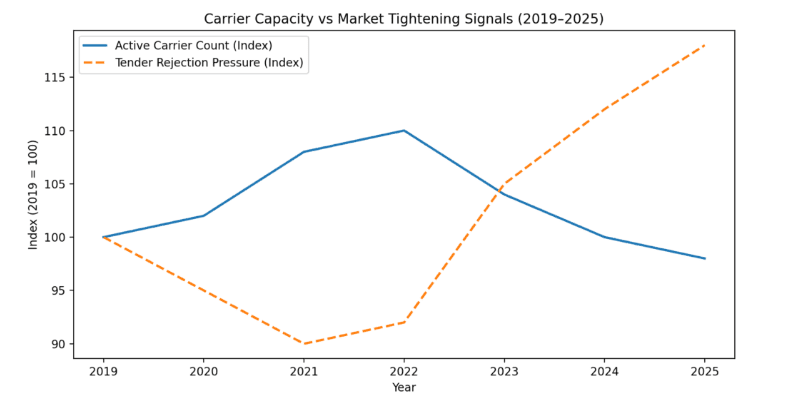
Operators who currently run reliable lanes with predictable service benefit from this. Even though the headline data appears to be improving, those anticipating a sudden shortage of trucks frequently see little improvement.
Who gains first depends on readiness rather than involvement.
Why More Miles Is the Wrong Goal
Increasing mileage is no longer a surefire way to make money. More miles frequently just translate into thinner margins, increased maintenance exposure, and more deadheads.
Better miles are more important than total miles in the current cycle. Tighter schedules, predictable reloads, and fewer repositioning moves are more profitable than merely chasing utilization.
In 2026, many of the most reliable owner-operators will run fewer businesses than they did in the past while retaining a larger portion of their profits.
Where Dispatch Support Fits in a 2026 Market
The state of the market going into 2026 favors professionalism over optimism. Successful owner-operators tighten operations, safeguard cash flow, and make fewer but better decisions.
Owner-operators seeking structure in a volatile market are served by Dexter Dispatch Services. Instead of running more freight, the goal is to run the right freight through consistent execution, realistic rate floors, and disciplined lane selection.
The goal is the same whether working alone or with dispatch assistance: keep control of the company rather than responding to the market.
Conclusion
Perfect timing is not necessary for the 2026 trucking market. Operational clarity is necessary.
Owner-operators are better positioned to withstand uncertainty and seize opportunities when they arise when they approach dispatch as a system rather than a rush. The most underappreciated benefit in trucking is still longevity rather than volume.
Refrigerated Freight Services provide temperature-controlled transportation to protect perishable goods during transit.
Additionally, longevity is developed one choice at a time.
👉 Contact Dexter Dispatch Services at www.dexterdispatchservices.com or call us at [682-336-0385]