

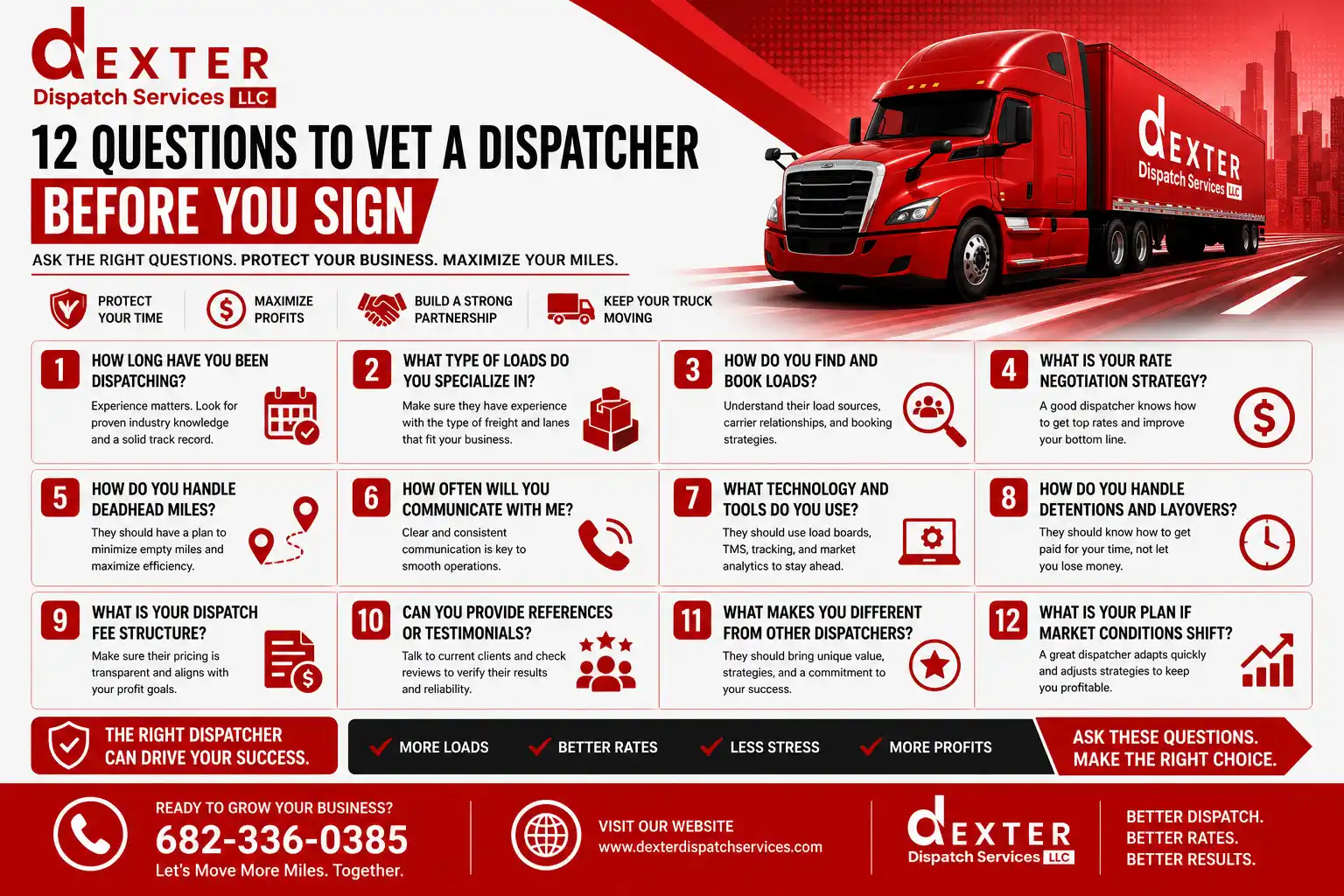
12 questions that distinguish between operator-aligned dispatch and a “load flipping” dispatch shop.
There are 3 dispatch services on a call list. These are available for a different charge for each one. Each will deliver improved loads. There are no different-sounding pitches above the surface. It is not in the pitch that the answer is. The solution is in 12 specific questions.
When it comes to comparison, most operators are price & personality. That selects the easiest to deal with salesperson, not the most effective dispatcher. Below are questions that will not allow the rep to speak about promises, but instead, workflow.
Asking about fees first is the right move, not the rude one
In some cases, fee queries are kept till the end. If not, then the call has 50% completed. Lead with money. The fee schedule informs you of the type of work the dispatcher is paid to undertake.
The higher the rate per load, the flatter the percentage of gross rewards. Its weekly flat fee is a pay-by-consistency and not a chasing scheme. Per load pricing pays for quality – volume – quality.” All of these are correct. Each one guides the dispatcher in another direction, though.
The first four questions are about money flow
Start here. If they avoid talking about money, then the remainder of the call is all show.
- How do you charge, and how do you break down your charges with my gross? A 5% cut on $7,000 weeks and on $4,500 weeks is not the same job. Be on the lookout for any non-specific response, such as “we keep it fair.” Fair isn’t a number.
- What is paid out TONU, detention, layover, and who is going to run the brook after the same? A genuine operator-side dispatcher goes in fear of detention each week. Bad answer: “That’s up to the broker. That actually implies that no one is fighting for it.
- How are settlements done weekly? You need a line-by-line statement: load, gross, fee, accessorials, deductions. If their answer is “we send a summary”, Sundays will be spent rebuilding their math.
- Day 30, what do I do if I want to renegotiate or I want to walk? HONEST dispatchers all have day 30 checkpoints. Listen for “we sit down and take a look at the numbers together. Hear against “you signed a contract.”
The first 4 questions are what make the difference between paying for a service and paying for a sales pitch. You should analyze and test the fee math under your own spreadsheet. The dispatch rate breakdown shows what money leaks by each model to see what you’re getting for your money.
The next four expose how they actually book loads
This is where load-flippers just get caught. The question of the booking process is one of workflow and not marketing! The responses should read like a brother’s and sister’s pub meeting on a Tuesday morning, not a brochure.
- Do you pre-schedule deliveries – before or after? Pre-delivery is reloading positioning. Post delivery is deadhead and cold board. A poor response is one that is similar to ‘we’ll wait and see how the day goes.
- What to do with the below floor load during times when your business is not busy? The answer to the above question is “we call you and ask.” which is a compliment, but true. The bad answer is, “we book what is available.” The lowest under your floor – by far – is $1.20 mile.
- What about dead heads and ways to enforce my lane preferences w-w? The two or three long, main lanes should be named back to you on the call by the dispatcher. If they cannot, that means that they are not able to read the file.
- How many trucks do you have per dispatcher? A working desk should be 8-12 feet wide. Twenty Plus is a row in a spreadsheet. Be on the lookout for the rep who refuses to answer this question.
The booking process is where the magic of moving your week actually happens. If you’re still on the spot market every Friday afternoon, it’s because you’re using a dispatcher who books reactively. Two days in advance, booking is a dispatcher with your truck loaded on Monday.
If you can’t answer the first 8 without a hassle, then the last 4 are a piece of cake. Do a full list prior to your next renewal conversation.
The last four questions are about authority and ownership
This is when operators get hurt a year later. The first 8 questions concern workflow. These 4 are on what to do when the relationship is not new anymore.
- Are you able to do the signing on my behalf, or can you coordinate only? Coordination: They pass loads for review. Agencies are those that join your MC. You want to be able to say “it is this,” NOT “it seems this,” before you run the first load.
- Do you or I own the broker relationships? Let’s say they owned the relationships, then when they leave the dispatcher, they’ll take the broker book with them. If you do, the broker calls yours, not the other way around.
- Do you process paper documents such as rate cons, BOLs, lumper receipts, etc.? The correct answer has to do with a shared folder and handoff. The incorrect answer is ‘we forward emails’.
- How is the issue dealt with when I’ve got a problem load, a chargeback, or a dispute? An actual desk has a documented escalation procedure. A flipper responds, “we will look into it.” Looking into it is not a process.
The authority questions are those questions that the operator does not ask the first time the call is made. They do not feel comfortable asking. Ignore them, and the solution comes to light four months later.
How the answers actually compare
You are not grading each answer pass or fail. You are listening for the shape of the operation. Three services will give you twelve answers each. Lay them next to each other.
| Signal | Operator-aligned answer | Load-flipper answer |
|---|---|---|
| Fee structure | Specific percentage or flat, with reasoning | “We keep it competitive” |
| Below-floor loads | “We call you first” | “We book what we can find” |
| Detention recovery | Named process, weekly cadence | “The broker decides” |
| Trucks per dispatcher | Direct number, 8-12 range | Refuses or says “depends” |
| Day 30 | Built-in review | “You signed a contract” |
One service will sound sharper on money. Another on workflow. A third on authority and paperwork. The one you want is the one that has a clear answer for all twelve, and whose answers match how you actually run your truck.
All three services sound fine” usually means you stopped listening
Again, if all the services are the same, then the questions were not hard. Click on the second answer. “Take me for a ride on one of your trucks, last Tuesday”. A real desk means you can have a timeline. Flipper provides you with a slogan.
Normal operational cost per mile, as shared in the ATRI 2025 Operational Cost Report, is $2.27 per mile. If you are spending a fortnight on $1.85 lanes, a dispatcher will cost you more than he will save. The 12 questions are there because the cost of the wrong answer appears on the next month’s settlement, and not the sales call.
Quick decision rule
- If 2 or more answers are unknowledgeable about money, cancel the services.
- If they say “no” to trucks-per-dispatcher, then leave the service.
- Do not retain the service if they refuse to do a day-30 review.
- Go through all 12, giving a real-world answer to the question, and if your instincts say ‘this sounds like my operation’, shortlist them.
The fee is the least important for the decision. It is the entire workflow that is behind the fee. A 5% dispatcher who books reload before delivery, sits on detention every week, is better than a 3% dispatcher who books off at 4 pm on Friday on a cold board. People aren’t selling you a per cent. You are spending a Tuesday morning, and you have to pay for it.
If you can’t get clear answers from your current service on any of these 12, then it is not a personality problem. It is a matter of operating model issues. It is not a fee structure matter; it’s a booking behaviour issue. In short, that’s what the twelve questions boil down to, and that’s the “next month” settlement’s turning a blind eye to.
👉 Contact Dexter Dispatch Services at www.dexterdispatchservices.com or call us at [682-336-0385]